Impermanent Loss 101: How DeFi Yields Really Work
High APRs in DeFi liquidity pools look tempting, but they come with trade-offs that aren’t always obvious. This guide explains impermanent loss, why it happens, and how to think more clearly about yield.
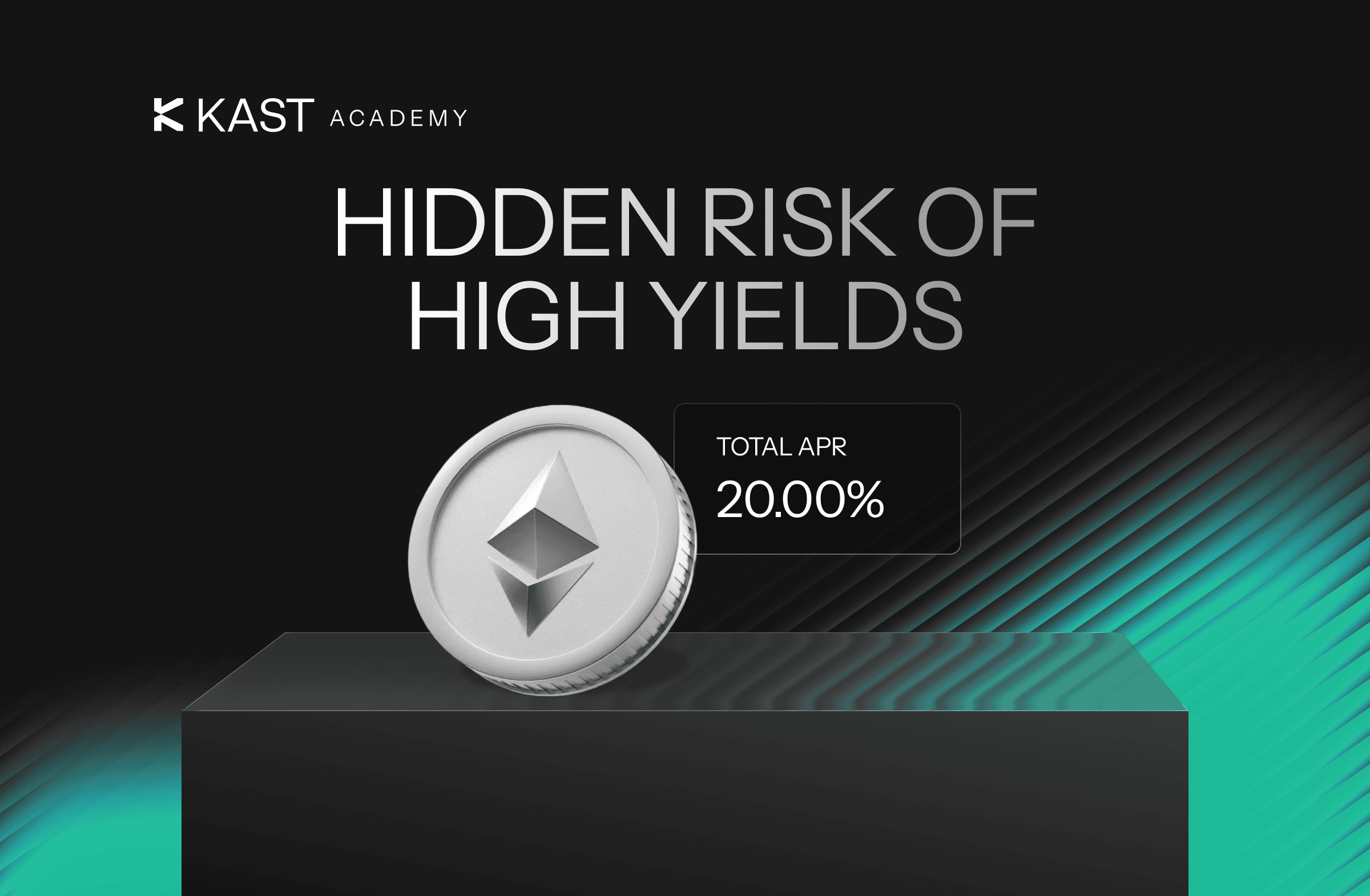
Key Takeaways
- High APR liquidity pools can underperform simple holding because AMMs automatically rebalance your assets when prices diverge.
- Impermanent loss is not a fee or penalty, but the mechanical result of how liquidity pools maintain prices.
- KAST Earn generates yield through a managed USD vault rather than AMM liquidity pools, so you are not exposed to impermanent loss.
A pool is flashing a big APR. Two clicks later, you’re “earning yield.” And you’re already doing the math in your head.
That reaction makes sense. Most Decentralized Finance (DeFi) dashboards are great at showing the upside. They are much quieter about the trade-off that comes with it.
One of the biggest trade-offs has a deceptively polite name: impermanent loss.
To understand what’s going on, you need to see how DeFi yields really work.
Most people start with a simple assumption: if you deposit two tokens into a liquidity pool and earn fees, you should end up with your tokens plus extra. That logic makes sense. The catch is that liquidity pools do not behave like that.
This guide shows you what impermanent loss is, how to minimize the risks around it, and how KAST handles yield without exposing you to impermanent loss.
How AMMs Rebalance Your Assets
Most liquidity pools in DeFi are powered by automated market makers (AMMs).
When you provide liquidity, you deposit two assets (for example, ETH and USDC), and traders swap against that pool. As trades happen, the pool automatically adjusts how much of each token it holds to keep prices aligned.
So even if you never touch your position, the pool is continuously rebalancing what you own.
For a 50/50 pool, impermanent loss can be calculated using:
IL = 2 × √(price ratio) / (1 + price ratio) − 1
Here’s the part most people miss: when the prices of the two tokens move apart, the pool tends to leave you with more of the token that underperformed, and less of the token that outperformed.
That difference between:
- what you end up with as a liquidity provider, and
- what you would have had if you simply held the same two tokens,
is impermanent loss.
What Is Impermanent Loss?
Impermanent loss is the difference in value between:
- holding the tokens in your wallet, versus
- providing liquidity with those same tokens.
It is not a fee the protocol charges you. It is the result of the AMM’s rules.
It is called “impermanent” only because if prices return to their original ratio, the gap can shrink. If you withdraw while prices are still far from where you started, that underperformance becomes permanent.
Yes, the name is doing a lot of PR work.
A Simple Impermanent Loss Example
Imagine you add liquidity to an ETH/USDC pool when 1 ETH = 2,000 USDC.
Later, ETH rises to 3,000 USDC.
That sounds like a win. But the pool needs to keep a tradable price, so traders buy ETH from the pool as it rises. Over time, that means the pool holds less ETH and more USDC.
So when you withdraw, you may have fewer ETH than you started with.
Compared to simply holding your original ETH and USDC, your position can be worth less. That gap is impermanent loss.
Here’s what that looks like numerically in a standard 50/50 pool:
- If one asset increases 2× relative to the other, impermanent loss is approximately 5.7%.
- If one asset increases 3×, impermanent loss rises to about 13.4%.
- If one asset increases 5×, impermanent loss reaches roughly 25.5%.
This does not mean you lose 25.5% of your deposit. It means your position is worth 25.5% less than it would have been if you had simply held the original tokens instead of providing liquidity.
Can fees offset it? Absolutely. Do they always? No.
This rebalancing cuts both ways. If ETH falls, the pool rotates you into more ETH as traders sell into the pool. In that case, you can end up with more ETH than if you had simply held ETH and USDC outside the pool.
That can feel like a benefit if your goal is accumulating ETH, but it is the same mechanism, and the outcome still depends on price moves and when you withdraw.
Why High APR Pools Often Come With Impermanent Loss
If you’re seeing unusually high yields in a pool, it often comes with at least one of these conditions:
The pair is volatile. When the two assets move a lot relative to each other, the rebalancing effect becomes more expensive.
The “yield” is mostly incentives. Some pools pay extra rewards to attract liquidity. Those rewards can be real, but they are not the same as organic fee income. Incentives can shrink, end, or be paid in a token that drops.
Fee income is uncertain. Trading fees depend on volume. If volume slows, your fee income slows too. Impermanent loss does not.
In practice, the pools that flash the biggest APRs are often the ones where trading volume is high and/or incentive tokens are being distributed.
Impermanent Loss vs APR
High APR can catch your eye, but it doesn’t tell the full story.
APR (Annual Percentage Rate) shows expected returns based on fee income and incentives, but does not factor in the value changes caused by price divergence between assets.
Impermanent loss, on the other hand, reflects the relative performance difference between holding tokens and providing liquidity.
For example:
- A pool might show 40% APR in rewards.
- If the underlying assets diverge sharply, the impermanent loss could be greater than 40% over the same period.
- In that case, even with fees and rewards, your net return might be negative compared to just holding the tokens.
This is why high APR numbers can be misleading: they highlight upside from fees and incentives, but they don’t include downside from price impact and divergence. Always compare APR with potential impermanent loss before deciding how to allocate capital.
Examples of High-APR Pools With Impermanent Loss Risk
These are examples of pools that can show high headline APR, but where impermanent loss can be meaningful because both assets are volatile and can diverge.
- WBTC / WETH on Uniswap V3 (Ethereum)
- Example pool: Uniswap WBTC/WETH pool
- Why APR can be high: WBTC and WETH are heavily traded assets. In Uniswap V3, LPs earn a share of swap fees, and active trading can translate into higher fee APR.
- Why IL can be high: BTC and ETH do not move perfectly together. If one outperforms, the AMM rebalances you away from the winner and toward the laggard.
- ETH / LINK on Uniswap V3 (Arbitrum)
- Example pool: Uniwsap ETH/LINK Pool
- What it is: a liquidity pool that facilitates swaps between ETH and LINK.
- Why APR can be high: during periods of heavy ETH or LINK trading, swap volume can spike.
- Why IL can be high: ETH and LINK can diverge sharply. If one moves faster than the other, the AMM rebalances you into more of the weaker asset.
Because LINK tends to be more volatile than BTC, ETH/LINK pools often display higher APR than ETH/BTC-style pools, reflecting higher trading activity and faster price movement.
With concentrated liquidity on Uniswap V3, you choose a price range where your liquidity earns fees. Outside that range, fees stop, while price movement continues, which can increase impermanent loss. This gives higher fee potential, but with less room for error.
The point is not that these pools are “bad.” It’s that with volatile pairs, APR is only one side of the story. The other side is how much divergence you’re paying for.
When Impermanent Loss Is Usually Low
Impermanent loss is driven by how much the price ratio changes. So it tends to be smaller when the two assets move together.
This is the most common in stablecoin to stablecoin pools (like USDC/USDT).
That’s also why these pools usually have lower yields. You do not get paid much for taking a risk you are not taking.
What Often Goes Wrong
These outcomes usually surprise people, but they are all side effects of the same rebalancing process.
Most LP regret comes from familiar situations:
You withdraw after one token makes a big move, and the pool has already rotated you away from it.
Rewards look great on day one, but the reward token falls faster than the rewards add up.
Fees drop when trading slows, and the fee income stops covering the underperformance.
None of this is a scandal. It’s just the mechanism doing exactly what it was designed to do.
If you are providing liquidity, be clear on what the assets are, how likely they are to diverge, and if the yield comes from trading fees or incentives.
If you can answer those clearly, you’re already ahead of most people.
How to Reduce or Avoid Impermanent Loss
Impermanent loss risk is tied to how much the ratio between two assets changes over time. Here are practical ways to reduce or avoid it:
1. Choose Stablecoin Pairs
Pools with two stable assets (e.g., USDC/USDT) have minimal price divergence, which significantly reduces impermanent loss.
2. Use Correlated Assets
Pairs like ETH/stETH or WBTC/wETH tend to move together, which lowers divergence risk compared to unrelated asset pairs.
3. Consider Single-Sided Yield Products
Instead of providing liquidity, some protocols offer yield on a single asset without requiring a matched pair, eliminating the impermanent loss mechanism entirely.
4. Evaluate Incentive Structures
High rewards can offset some loss, but always check whether incentives are temporary or sustainable.
5. Shorter Time Frames
Impermanent loss grows as assets diverge. If prices remain stable over shorter periods, loss is smaller. Planning ahead based on volatility outlook can help.
Impermanent loss is inherent to AMM mechanics, but thoughtful asset selection and strategy can make yield provision less risky.
How KAST Earn Avoids Impermanent Loss Mechanics
Impermanent loss is primarily a liquidity pool risk. It exists because AMMs automatically rebalance a two-token position.
KAST Earn is not a liquidity pool position. It is not trying to pay you by rebalancing you between two volatile assets.
Instead, KAST Earn routes USD into a managed vault (the Gauntlet USD Alpha vault) that allocates across yield sources that are structurally different from AMM liquidity providing. The goal is to earn yield without relying on the LP trade-off you just learned about.
That does not mean “no risk.” In crypto, that sentence does not exist. But it does mean the yield mechanism is different, and so are the risks.
If you’re comparing yields across products, this is the key takeaway:
Sometimes the highest headline APR is just the most expensive mechanics, wearing a nice number.
Final Thoughts on Impermanent Loss
If you’ve ever looked at a pool APR and thought, “That seems… generous,” that instinct is doing its job.
Impermanent loss is the cost of letting an AMM rebalance you. Sometimes fees cover it. Sometimes they don’t.
Understanding impermanent loss is essential before providing liquidity to any AMM-based DeFi protocol.
You shouldn’t have to learn that the hard way. Now you don’t.
Disclaimer: This content is provided by KAST Academy for educational purposes only and is not intended as financial advice or a recommendation to engage in any transaction. All information is provided "as-is" and does not account for your individual financial circumstances. Digital assets involve significant risk; the value of your investments may fluctuate, and you may lose your principal. Some products mentioned may be restricted in your jurisdiction. By continuing to read, you agree that KAST group, KAST Academy, its directors, officers and employees are not liable for any investment decisions or losses resulting from the use of this information.
Related articles
Staking vs. Lending: A Beginner’s Guide to Safer Yield
Staking and lending can look similar in crypto, but they work for very different reasons. This guide breaks down how yield really works, what can fail, and how to choose the safer strategy for your situation.
Where Does Stablecoin Yield Come From?
Stablecoin yield comes from real onchain demand, borrowing, trading, and capital deployment, not inflation or promos. When demand rises, yields rise. When it falls, so does yield.
What Is RWA Backing? Tutorial on How Treasury Bills Secure Your Yield
Real-World Assets (RWAs) bring familiar assets like U.S. Treasury bills and bonds onchain. RWAs let you earn yield backed by traditional financial instruments. This guide explains how RWA backing works, why it exists in crypto, and how KAST Earn uses it to help you generate steady yield.