Where Does Stablecoin Yield Come From?
Stablecoin yield comes from real onchain demand, borrowing, trading, and capital deployment, not inflation or promos. When demand rises, yields rise. When it falls, so does yield.
Key Takeaways
- Sustainable stablecoin yield is driven by real economic activity, such as lending, trading fees, and interest from traditional finance assets such as tokenized Treasury Bills.
- Rates move with market demand, so yields rise when stablecoins are in demand and fall when capital sits idle.
- Understanding where yield comes from helps determine your risk appetite and choose options that fit how you want your money to work.
Stablecoins are designed to hold their value. One USDC today is intended to be worth one dollar tomorrow, next week, and next year.
So when you see offers like “Earn 5% APY on your USDC”, a reasonable question follows:
Where does that yield come from?
Stablecoin yield is the return you earn when your USDC or other stablecoins are used in onchain lending, trading, or real-world asset strategies.
In this guide, we explain where stablecoin yield comes from. At the end, we’ll show how KAST Earn gives you access to this yield without managing Decentralized Finance (DeFi) protocols yourself.
How Stablecoin Yield Works
Stablecoin yield comes from a mix of on-chain borrowing demand and the interest earned on the real-world assets (like Treasuries) backing the coins.
Also, various temporary incentives are subsidies used to bootstrap new protocols or attract liquidity.
People and protocols need stablecoins for real economic activity:
- Borrowing
- Trading
- Providing liquidity
- Deploying capital into tokenized traditional finance assets
When demand for stablecoins is high, borrowers and traders are willing to pay more to access them. When demand is low, rates fall.
In market conditions where there is a liquidity shortage, lenders can see higher returns.
There are no fixed returns. Stablecoin yields move because this is a real market.
When you supply stablecoins, you’re making this activity possible. In return, you earn a share of the total value being generated.
This is not staking. You’re not securing a network.
You’re supplying capital and getting paid because others need it.
Your dollars are working.
Where Stablecoin Yield Comes From
There are many yield strategies in DeFi protocols, but most stablecoin yield comes from three places.
1. Lending Protocols
The most common source of generated stablecoin yield is onchain lending.
You deposit stablecoins into a shared pool on platforms like Aave, Compound, or Morpho. Borrowers come along, put up collateral, take out loans, and pay interest.
You earn a portion of that interest payment.
How much you earn depends on how much borrowing demand there is:
- High demand = You earn more
- Low demand = You earn less
If a lot of money flows into a protocol but borrowing doesn’t increase, some capital sits idle. When that happens, yields fall.
The beautiful part? Everything is transparent. You can check pool balances, see how much is being borrowed, and watch rates update, all onchain.

- Market Cap
- Total Supply
- 24h Volume
- Peg
- Avg Deviation
- Collateral
- Cash, US Treasuries + Assets
- Governance
- Centralized
- Funds Freezable
- Yes
- Issuer
- Tether Limited
- Jurisdiction
- British Virgin Islands
Historical Incident: Tether has faced scrutiny regarding the full backing of its reserves.
Live market data sourced from DefiLlama (opens in new tab) and CoinMarketCap (opens in new tab)
2. Liquidity Provision
Decentralized exchanges and platforms need liquidity to work. Without it, nobody can trade.
When you add stablecoins to liquidity pools, you're enabling people to swap crypto assets without relying on a centralized order book. Every time someone makes a trade, they pay a small transaction fee. You get a cut.
Stablecoin-to-stablecoin pools are popular because:
- Prices stay relatively stable
- Impermanent loss is minimal if both assets maintain their peg to the dollar.
- Returns are smaller but more predictable
Liquidity provision isn’t completely passive. Positions need monitoring, and returns depend on trading volume.
3. Real-World Assets (RWAs)
Some DeFi protocols earn yield by deploying stablecoins into tokenized traditional assets like U.S. Treasury bills.
This is known as stablecoin yield from RWAs, where onchain dollars earn returns backed by traditional finance instruments.
Because of this, RWA yields tend to be more predictable than purely crypto-native strategies.
Today, large issuers like BlackRock and Franklin Templeton offer onchain funds with RWA yields.
Total RWA value onchain has grown quickly and exceeds $24 billion as of February 2026.
Advanced Stablecoin Yield Strategies
Beyond lending, trading fees, and RWAs, there are more advanced ways stablecoins can generate yield. These strategies are more complex and require active management.
Arbitrage and market making strategies capture small price differences across markets, such as platform price gaps or funding rate mismatches. These opportunities are short-lived and rely on automation and constant risk monitoring, so most people access them through managed vaults rather than running them directly.
Yield-bearing stablecoins build yield directly into the token. The issuer manages the strategy behind the scenes, combining your principal and returns into one asset.
Examples include algorithmic stablecoins such as Ethena’s sUSDe, Level’s slvlUSD, Falcon Finance’s sUSDf, and Resolv’s stUSR. These yield-bearing stablecoins can offer higher yields than basic lending, but they’re harder to evaluate and less predictable.

- Market Cap
- Total Supply
- 24h Volume
- Peg
- Avg Deviation
- Collateral
- Crypto backing + delta-hedging derivatives positions
- Governance
- Semi-decentralized
- Funds Freezable
- No
- Issuer
- Ethena
Historical Incident: USDe is not fiat based, it relies on a delta neutral hedge design.
Live market data sourced from DefiLlama (opens in new tab) and CoinMarketCap (opens in new tab)
These strategies sit at the advanced end of decentralized finance. They provide useful context, but they’re not designed to be simple savings options.
Stablecoin Yield Key Risks
Not all yield opportunities are created equal. There are clear rules to follow if you want to reduce your risk.
When you see high APYs, there's usually a reason. Higher risk, more leverage, or temporary incentives.
If a protocol is paying you mostly in their own token, watch out. Those yields tend to crash once the incentive program ends.
Sustainable yield comes from real, observable activity:
- Borrowers paying interest
- Traders paying fees
- Protocols earning consistent revenue
- Tokenized treasuries
If you can't figure out where the yield is coming from, be cautious.
For more information on risks associated with popular stablecoins, read: "Can a Stablecoin Lose its Value? Real Risks Explained"
Stablecoins are also moving into clearer regulatory territory. The Senate Banking Committee has advanced the GENIUS Act, while proposals like the Clarity Act aim to define how different parts of the crypto industry are supervised.
Policymakers, including the White House and the SEC chairman, are shaping rules around reserves, disclosures, and oversight. As stablecoins become more connected to treasury operations and interest rate discussions, regulation is becoming part of how this market matures.
How KAST Earn Generates Stablecoin Yield
KAST lets you hold, move, spend, and earn on your USD from one app.
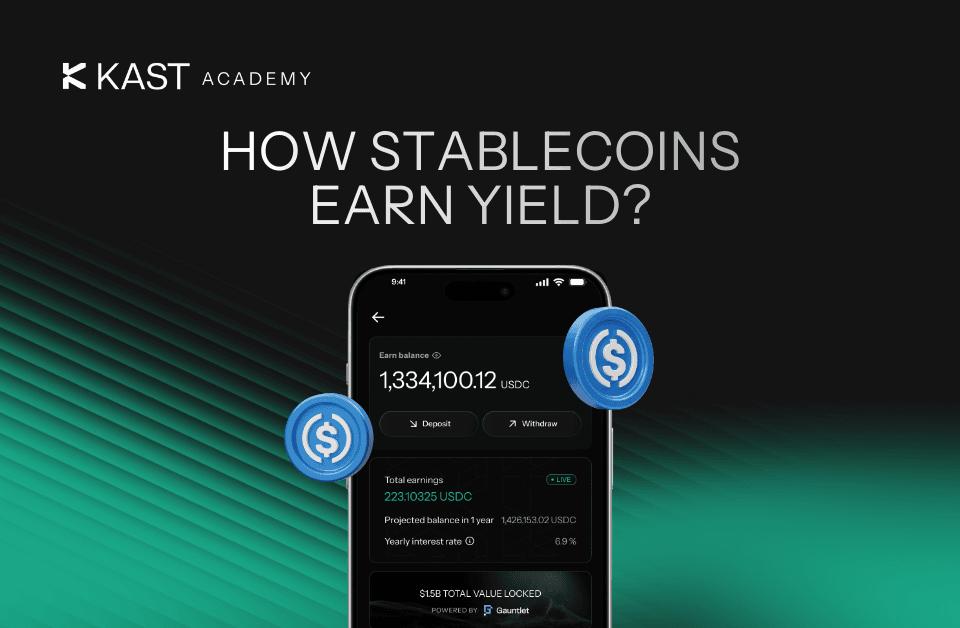
When you deposit USD into the KAST app, your funds are deployed into the Gauntlet USD Alpha vault.
Gauntlet is a leading risk manager in DeFi. They manage large amounts of capital across established lending protocols and adjust positions as market conditions change, with a focus on capital preservation and risk-adjusted returns.
Here’s what happens:
- You deposit USD in the app
- Your funds are converted into vault shares
- Those shares represent your portion of the vault
- Yield accrues automatically over time
- You can deposit or withdraw whenever you want
Your funds remain custodial. There are no lockups and no manual rebalancing required.
Summary
KAST Earn is built around a few core principles:
Here's the Bottom Line
Stablecoin yield isn't magic. It comes from real things: borrowers paying interest, traders paying transaction fees and DeFi protocols earning revenue.
The problem is that accessing it directly takes time, expertise, and capital most people don't have.
KAST Earn fixes that. Professional management. Institutional-grade strategies. Transparent execution. All in one app. No DeFi degree required.
What you get:
✓ You control deposits and withdrawals
✓ You can move money in or out anytime
✓ You earn yield without managing DeFi positions yourself
Your USD earns instead of sitting there.
Open the KAST app and start earning today.
Disclaimer: This content is provided by KAST Academy for educational purposes only and is not intended as financial advice or a recommendation to engage in any transaction. All information is provided "as-is" and does not account for your individual financial circumstances. Digital assets involve significant risk; the value of your investments may fluctuate, and you may lose your principal. Some products mentioned may be restricted in your jurisdiction. By continuing to read, you agree that KAST group, KAST Academy, its directors, officers and employees are not liable for any investment decisions or losses resulting from the use of this information.
Related articles
What Stablecoins And Networks Are Supported By KAST?
Did you know KAST supports stablecoins like USDC, USDT, PYUSD, RLUSD and networks like Solana, Ethereum, Polygon, Tron, BSC, and more? Learn how to choose the right network based on transaction fees, speed, and compatibility.
Can a Stablecoin Lose Its Value? Real Risks Explained
Stablecoins are designed to hold a $1 value, but history shows they can lose their peg. This guide explains how stablecoins work, why depegs happen, which designs are riskier, and how KAST decides which stablecoins to support.
What Is Stablecoin Regulation and What Should You Know in 2026
Stablecoin regulation sets the rules for licensing, reserves, redemption, and reporting. This guide explains how major frameworks in the US, EU, Singapore, and Hong Kong shape stablecoin use and integration.