Cold Storage vs. Card Wallet: How Much Should You Keep on KAST?
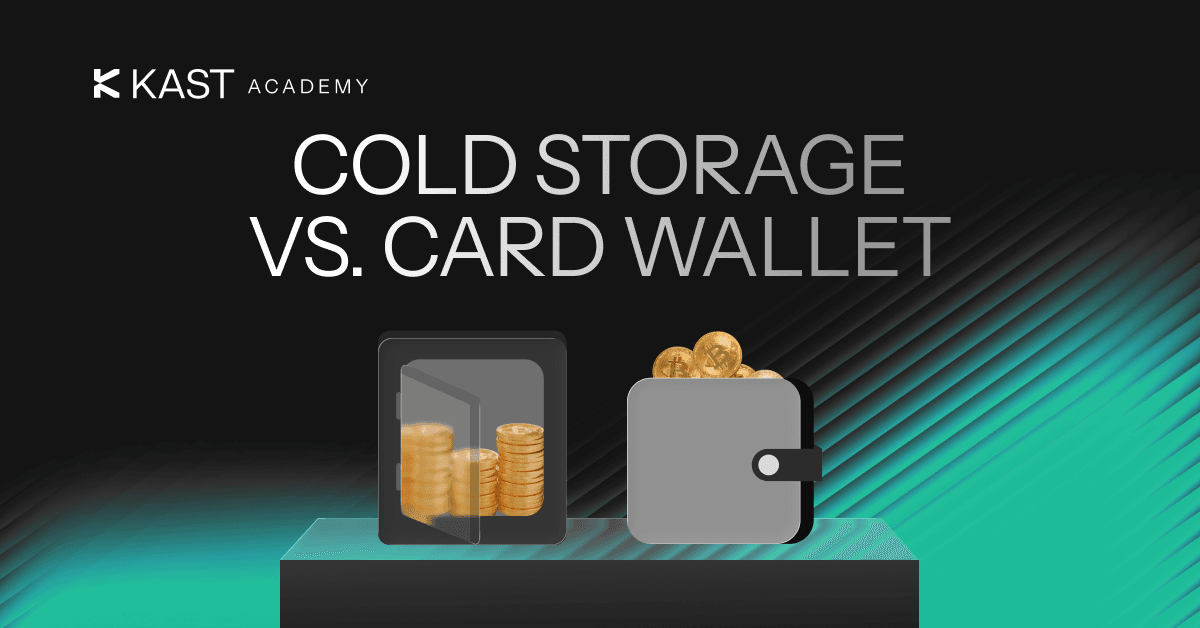
Most crypto advice frames storage as a binary choice. A better approach is separating long-term holdings from a working balance. Cold storage keeps funds safe by staying out of reach, while a card wallet like KAST keeps money accessible for spending, transfers, and everyday life.
Key Takeaways
- Cold storage and spending wallets are not competitors; they exist to do different jobs for different parts of your money.
- The right amount to keep on a spending wallet depends on how often you use your funds, not on a fixed percentage or magic number.
- KAST works best when treated like a crypto checking account with a predictable working balance, not a place for long-term holdings.
Most crypto advice starts with one question:
“Should I keep my money in cold storage or on the wallet I actually use?”
If you’ve been in crypto for more than five minutes, you’ve heard the rule: “Not your keys, not your coins.” That advice makes sense, but it’s incomplete.
Crypto security isn’t only about where you store funds. It is about whether your setup still works when you actually need to use your money.
Cold storage and everyday wallets serve different purposes. When you try to use one setup for everything, you usually create friction. Either money becomes hard to access, or it feels stressful to keep available.
KAST is built for the part of your crypto you want accessible, supporting spending, transfers, and day-to-day money management without unnecessary complexity.
Once you separate long-term crypto holdings from a working balance, the question is no longer “cold storage or wallet?” It becomes how to set things up so your money is usable, secure, and ready when life happens.
Cold Storage vs Card Wallet for Crypto Spending
Cold storage is built for one job: don’t touch it.
A card wallet is built for a different job: touch it often.
When people argue “cold storage vs wallet,” they're usually mixing two different buckets: long-term holdings you'd hate to lose, and a working balance you expect to spend, move, and manage.
If you try to use one bucket for both, you either keep too much in a hot wallet and stress constantly, or keep everything in cold storage and never use your money. Neither feels practical.
A Simple Rule of Thumb for Crypto Storage
Instead of asking “How much should I keep on my wallet?”, ask:
“How many days of spending do I want easy access to?”
A practical way to think about it:
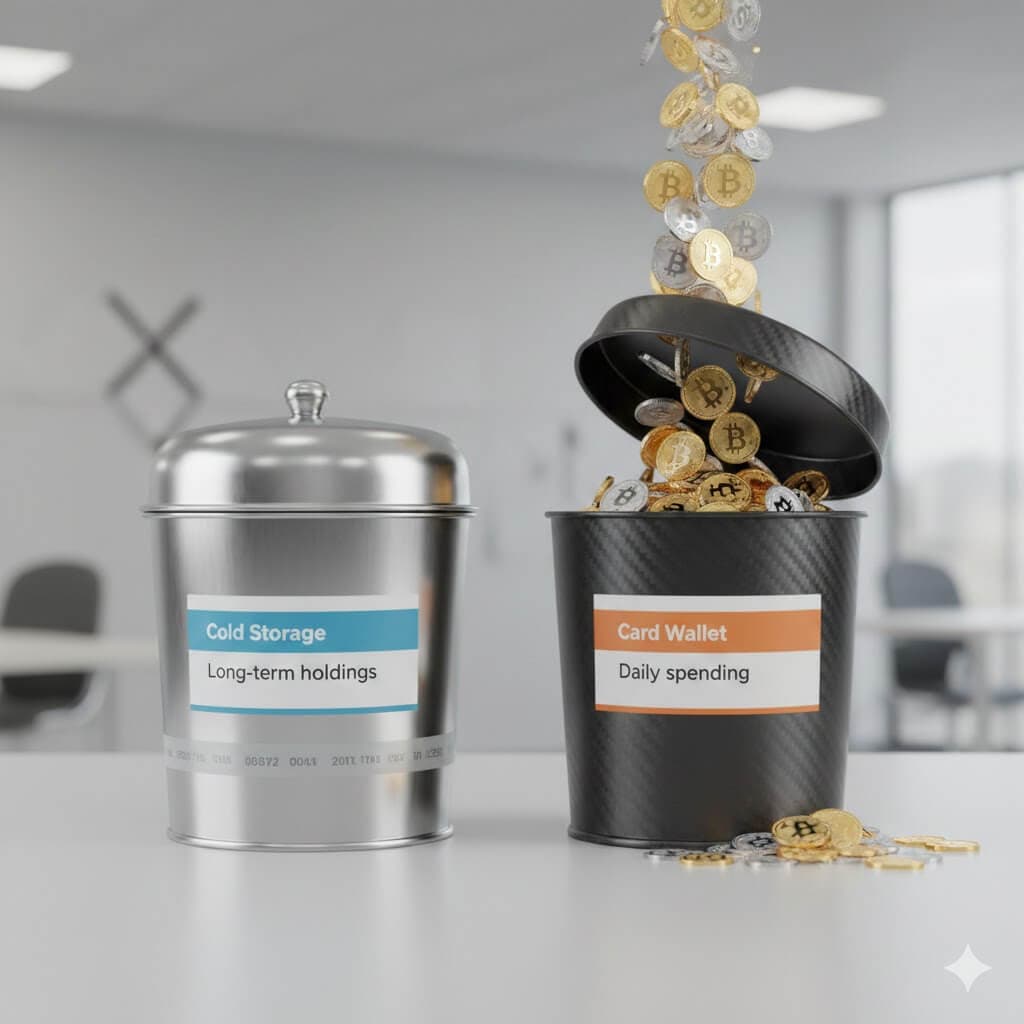
- Cold storage = “I don’t need this soon.”
- Card wallet = “I might need this in the next few days.”
The real risk isn't only hacking. It's also friction: missing a flight because funds are locked behind a hardware wallet, getting stuck mid-transfer because you need confirmations and cables, or paying extra fees to move money in a rush.
What Is Cold Storage and What Is a Card Wallet?
Cold storage refers to offline crypto storage, usually a hardware wallet. It’s harder to access, and much harder to compromise remotely because it isn’t connected to the internet.
A card wallet or spending wallet holds crypto you keep accessible for payments and everyday transfers. It's more convenient, and it requires more attention because you use it often.
Cold Storage vs Card Wallet: Trade-Offs
What Can Go Wrong and How to Prevent It
If You Keep Too Much in a Spending Wallet
You increase exposure to account takeover attempts (phishing, SIM swap, leaked passwords), device compromise (malware, stolen phone), and plain human error (wrong address, wrong link).
Prevention: use a unique password (ideally with a password manager), enable strong authentication, keep your device updated, and treat “support DMs” as scams until proven otherwise. Seriously.
If You Keep Too Little in a Spending Wallet
You increase exposure to urgent transfers at the worst time, extra steps (more chances to mess up), and more fees depending on how you move funds.
Prevention: keep a predictable working balance, and refill on a schedule (weekly or biweekly) instead of in emergencies.
What KAST Does
KAST makes the “spending wallet” bucket feel normal: keep a working balance ready for daily life, and refill it when you decide, not when you panic.
Unlike a random hot wallet, KAST is built to be used safely. Your account is protected with industry-standard measures like encryption, multi-signature security, continuous monitoring, and identity verification for regulated features.
That means you can move and spend money quickly without treating every transaction like a risk event.
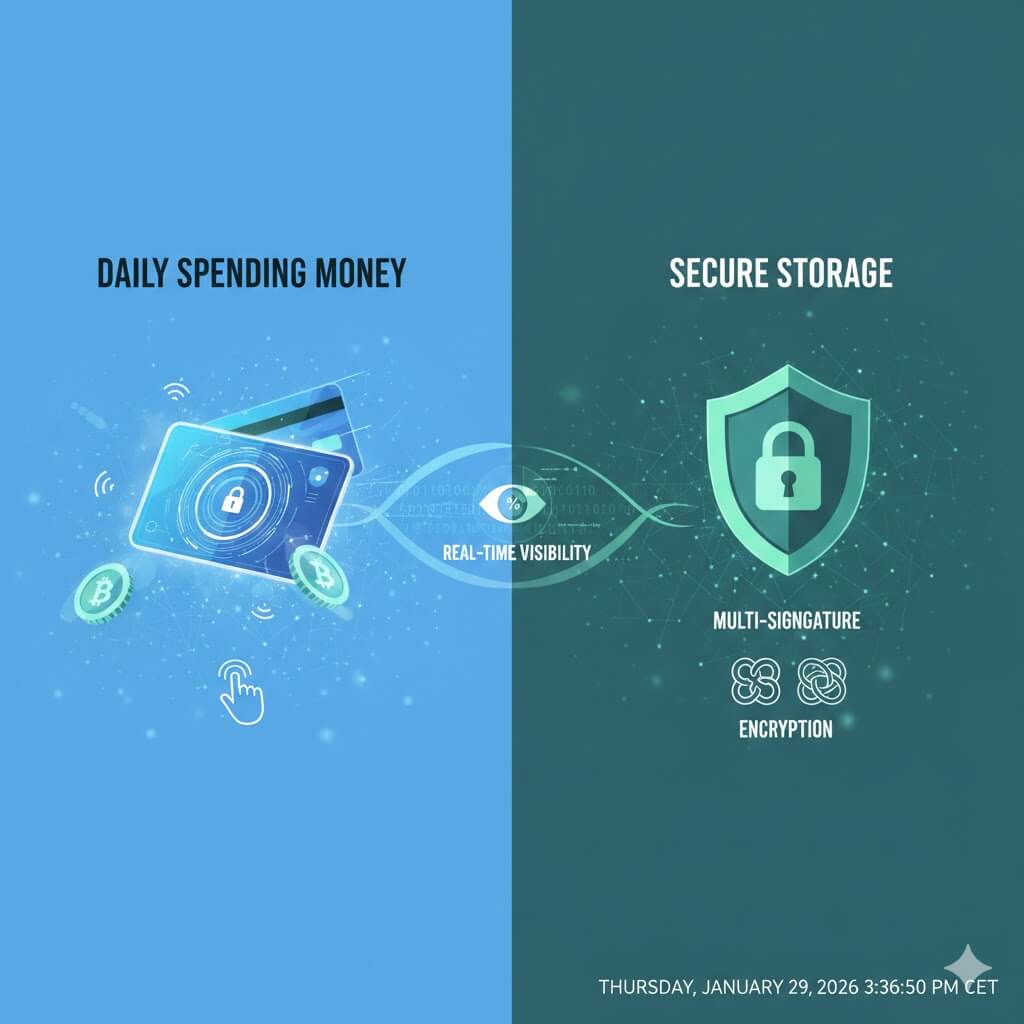
You also have full visibility. Your balance, transaction history, and security settings are always available in the app, so you stay in control of your crypto.
All KAST transactions run through KYC (Know Your Customer) and AML (Anti-Money Laundering) checks, handled quietly in the background. KAST works with regulated partners globally to keep conversions compliant and secure.
If you use KAST Earn, it can make sense to keep a slightly larger balance so accessible funds aren’t sitting idle. The same rule still applies: only keep what you’re comfortable holding in an account you use often.
How Much Crypto Should You Keep on KAST?
Here’s a sane way to decide, based on how you use money.
- Everyday spender (groceries, subscriptions, rideshares):
- Keep enough for your normal weekly spend.
- Refill once a week.
- Traveler / remote worker (hotels, flights, coworking, random surprises):
- Keep enough for your weekly spend plus a buffer.
- Refill before trips, not during them.
- Crypto-native investor (most funds are long-term):
- Keep a small working balance.
- Treat KAST like your "checking account," not your vault.
- Business / freelancer (cash flow matters):
- Separate "runway" money from "operating" money.
- Keep operating balance accessible, keep runway safer and less touchable.
Notice what’s missing?
A magic number.
Because your number is really your routine.
Where Each Part of Your Money Belongs
Cold storage is for money you don’t plan to touch for a long time. A card wallet like KAST is for money you plan to use.
Keep your spending budget on KAST (or a bit more if you’re using KAST Earn), not your life savings. Refill on a schedule, not when something goes wrong.
When your crypto is set up this way, you’re not choosing between safety and usability. You’re giving each part of your money a clear job and letting it support your daily life.
That’s the balance. And once you find it, things get a lot simpler.
Disclaimer: This content is provided by KAST Academy for educational purposes only and is not intended as financial advice or a recommendation to engage in any transaction. All information is provided "as-is" and does not account for your individual financial circumstances. Digital assets involve significant risk; the value of your investments may fluctuate, and you may lose your principal. Some products mentioned may be restricted in your jurisdiction. By continuing to read, you agree that KAST group, KAST Academy, its directors, officers and employees are not liable for any investment decisions or losses resulting from the use of this information.
Related articles
What Is Identity Verification And Why Do Cards Ask for It?
Identity verification is required before you can use a crypto card. This guide explains why KYC exists, what it checks, and how KAST verifies users to keep accounts secure and compliant.
Can I Withdraw Cash at an ATM Using My Crypto Card?
Crypto cards can withdraw cash at ATMs worldwide, but understanding how the process works matters. This guide breaks down how crypto card ATM withdrawals function behind the scenes, where fees come from, what determines limits, and when using an ATM actually makes sense.
How Does a Crypto Card Work Behind the Scenes?
Ever tapped your card and thought, “Wait, did I just spend Bitcoin?” That’s the magic of a crypto card - simple on the surface, but powered by incredible tech underneath. Let’s unpack how it all works, and how your KAST Card makes it real, simple, and powerful for you.