Is My Money Safe? Complete Comparison of KAST vs RedotPay vs Gemini vs Bybit
“Safe” is not one thing. This guide breaks it into three layers and shows how four major platforms reduce risk in different ways.
Key Takeways
- “Safe” is not one thing. It is custody and fund handling, account access security, and what happens when something goes wrong.
- The same features can mean different things depending on whether custody is partner-based, custodian-based, or exchange-controlled.
- KAST is designed around using crypto like money, so the practical question is how its structure shifts custody and operational risk compared to other platforms.
You’re about to trust an app with your money. The first question probably shouldn’t be “what features does it have?”. It should be: is my money safe?
That concern is reasonable. Most people want to understand where risks can show up.
But here’s the real question: What does “safe” actually mean? It sounds simple, but it isn’t. When people ask if their money is safe, they’re usually lumping three or four different concerns into one word.
This article separates those concerns, then compares how KAST, RedotPay, Gemini, and Bybit try to reduce them.
Is My Money “Safe”?
In modern fintech and crypto apps, safety usually comes down to three layers:
- Fund handling — who holds your money and how it moves
- Account security — how your login and access are protected
- User protection — what happens when something goes wrong
You want to know if you are at risk. Fair enough.
So let’s walk through how KAST, RedotPay, Gemini, and Bybit handle each layer.
Same order each time. Same criteria. Cited sources where available.
Layer 1: Fund Handling
This is the big one. Who actually holds your money, who runs the app you use and how your transactions are processed.
KAST
KAST’s Terms describe KAST as a technology company, not a bank, and state that accounts are not insured.
KAST also states that some regulated services are provided by partners, and that certain services are delivered by third-party providers.
That means:
- Custody responsibility is distributed across regulated financial institutions.
- Different parts of the service may operate under different partner terms.
- The actual movement and storage of funds happen inside partner infrastructure.
- Transfers, conversions, and KAST Card credit line processing are handled within those regulated systems.
So what does that mean for you?
You are not relying on one in-house stack for everything, but the system can be more layered behind the scenes.
The trade-off? If something does need to be reviewed or restricted, more than one entity may be involved. This can distribute responsibility across multiple entities, but it can also add complexity behind the scenes.
RedotPay
Just like KAST, RedotPay doesn’t operate as a self-custody exchange or a regulated trust company. It uses a designated third-party custodian.
This means:
- Digital assets are held through a Custodian on your behalf.
- You’re assigned individual on-chain addresses.
- Assets are recorded as segregated in custody records.
- Private keys are controlled by the Custodian, not you.
- RedotPay is not acting as a fiduciary unless explicitly stated.
They’ve publicly announced a partnership with Cactus Custody which provides institutional custody infrastructure and HSM-based key management.
Custodial assets are not covered by traditional deposit insurance schemes. That’s clearly disclosed.
Operational liquidity for transfers and card settlement runs through the custodian and payment partners.
So structurally, custody is split: RedotPay runs the platform, while the custodian controls the assets.
Both KAST and RedotPay rely on third-party custody, but they structure it differently.
KAST distributes custody, payments, settlement, and card issuance across multiple regulated partners.
RedotPay anchors custody with a designated institutional custodian and operates its platform on top of that setup.
The principle is the same, but the structural approach is different.
Gemini
Gemini differs from KAST and RedotPay in several aspects. It operates as a regulated New York trust company under supervision of the NYDFS.
That means:
- Gemini itself is the legal custodian.
- Custody is centralized within the regulated trust entity.
- Gemini also describes third-party security assessments and certifications (including SOC and ISO references).
- It is subject to capital requirements and cybersecurity examinations.
Gemini’s operational wallets use a hardware-secured signing system where transactions require multiple encrypted key fragments combined across geographically distributed systems. Automated risk controls and role-based approvals are built into that process, so no single individual has unilateral control over the keys.
As a regulated New York Trust Company, Gemini is required to maintain specific internal control standards. These controls are overseen by the NYDFS, and its hot wallets are covered by $25 million in dedicated insurance.
Bybit
Bybit is similar to Gemini in running an exchange-based custody model.
That means:
- The exchange internally manages user asset custody.
- Cold wallets hold the majority of reserves.
- Multi-signature controls are used.
- Proof-of-Reserves reports are published.
Bybit states that most user funds are kept in cold wallets, while a smaller portion remains in hot wallets to support withdrawals and trading. This setup limits how much capital is exposed to online risk at any given time.
Operational wallets are managed internally. That’s necessary for withdrawals and real-time transactions. Centralized custody, operational control and risk.
Relative to Gemini, Bybit differs in regulatory status, legal custody structure and insurance coverage.
Layer 1 Comparison
Layer 2: Account Security
Now let’s talk about access.
Because if someone logs into your account, custody structure won’t save you.
This layer is about how your login and account access are protected.
KAST
Keeping your account secure starts with a few simple steps on your side. Use a strong password, enable MFA, turn on biometric login where available, secure your device, and never share verification codes, even if a message appears to be from official support.
KAST supports this with multiple layers of account-level protection, including strong password requirements, multi-factor authentication, biometric login where supported, device-level verification, and real-time fraud monitoring. Automated systems monitor unusual login activity and suspicious behavior to help prevent unauthorized access.
Authentication takes place at the app layer, while fund processing sits with regulated partners, so access control and custody are structurally separate.
RedotPay
Responsibility for login security also sits with the user. Documentation references identity verification requirements, monitoring of account activity and device data, fraud detection systems, and the authority to suspend or restrict accounts when necessary. Authentication happens at the platform level, while custody remains with the custodian, keeping access and asset control as distinct layers.
Gemini
Security controls reflect Gemini’s regulated trust structure. Two-Factor Authentication is mandatory, hardware security keys are supported, withdrawal address whitelisting is available, and device and session management tools are built in. Authentication, custody, and regulatory supervision operate within the same legal entity, creating tighter integration and more centralized responsibility.
Bybit
Security features include Two-Factor Authentication, anti-phishing codes, withdrawal address whitelisting, login alerts, device management tools, and internal risk scoring. Authentication and custody are both managed within the exchange’s infrastructure, meaning access control and asset custody operate within the same system.
Layer 2 Comparison
Layer 3: User Protection
Your funds are handled securely, and you are taking the right steps to protect your account. However, incidents can still occur. If they do, how are you protected?
KAST
If you suspect unauthorized access, support must be notified promptly. KAST’s Terms describe a dispute process and a 90-day window for card transaction disputes and chargebacks, handled according to card network rules. In some cases, investigations involve regulated partners, which means resolving an issue can require coordination across multiple financial institutions.
RedotPay
RedotPay provides layered protection across account access, card controls, and data handling. Users can secure their accounts with passkeys, email, phone, and authenticator apps, and control their card by setting limits, restricting transaction types, choosing currencies, or freezing it instantly.
RedotPay also processes data to verify identity, meet regulatory requirements, and help detect or prevent fraud, sharing it only with essential partners like payment networks and compliance providers. Together, these measures combine user control with platform-level safeguards.
Gemini
Fraud detection systems are built into the platform, alongside a structured dispute resolution process. As a New York trust company regulated by NYDFS, Gemini also provides formal escalation pathways beyond internal support. Crypto held in Gemini’s hot wallet is covered by insurance against specific risks such as platform breaches or insider theft.
Bybit
Monitoring systems operate in real time, and withdrawals can be subject to manual review. The exchange publishes Proof-of-Reserves reporting to provide transparency into holdings. Bybit states that user assets are backed on at least a 1:1 basis, with reserves and liabilities publicly verifiable through audits and onchain data, allowing users to independently confirm asset backing.
Layer 3 Comparison
What You Control vs What They Control
No matter which platform you choose, some things are on you.
You control:
- Your password
- Your MFA
- Your device security
- Whether you approve suspicious prompts
- How quickly you report something off
They control:
- Custody structure
- Operational wallet management
- Fraud monitoring systems
- Compliance screening
- Incident response
That split never changes. The difference is in how platforms handle their side of the deal
How Safe Is Your Money?
There isn’t one universal definition of what makes money safe or crypto safe.
KAST and RedotPay distribute custody responsibility across regulated partners or custodians. Risk is spread across entities rather than centralized.
Gemini centralizes custody inside a regulated trust company under NYDFS supervision. Responsibility is concentrated, but inside a supervised framework.
Bybit centralizes custody inside exchange infrastructure.
So the real question isn’t “which one is safe?”
It’s: who do you want holding operational control?
- Distributed across partners
- Centralized inside a regulated trust
- Centralized inside an exchange
Once you understand who holds the keys, and who answers to which rules, “safe” stops being vague. It becomes something you can judge for yourself.
Disclaimer: This content is provided by KAST Academy for educational purposes only and is not intended as financial advice or a recommendation to engage in any transaction. All information is provided "as-is" and does not account for your individual financial circumstances. Digital assets involve significant risk; the value of your investments may fluctuate, and you may lose your principal. Some products mentioned may be restricted in your jurisdiction. By continuing to read, you agree that KAST group, KAST Academy, its directors, officers and employees are not liable for any investment decisions or losses resulting from the use of this information.
Related articles
Cold Storage vs. Card Wallet: How Much Should You Keep on KAST?
Most crypto advice frames storage as a binary choice. A better approach is separating long-term holdings from a working balance. Cold storage keeps funds safe by staying out of reach, while a card wallet like KAST keeps money accessible for spending, transfers, and everyday life.
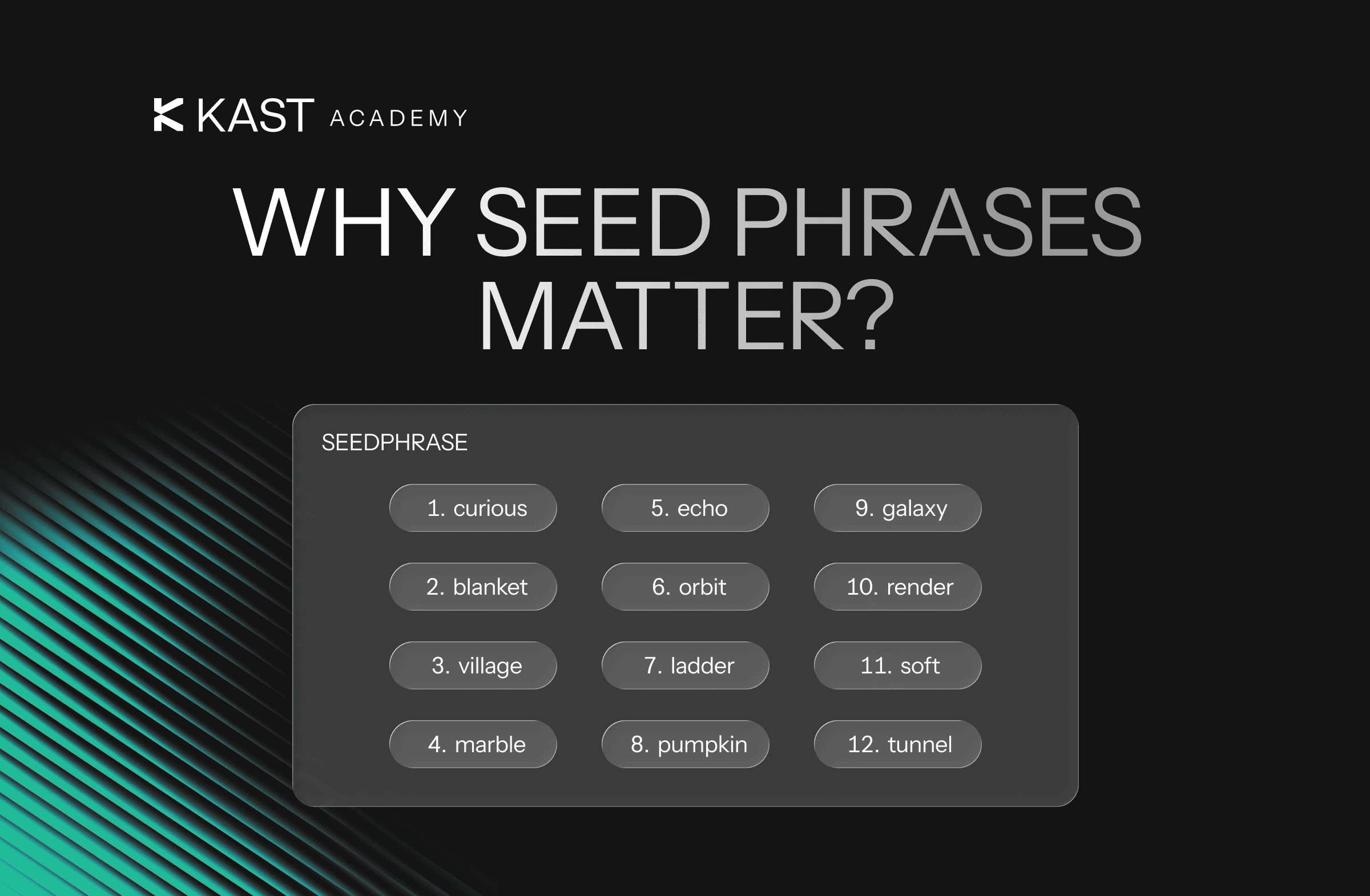
Seed Phrases Explained: Why KAST Handles the Keys for You
A seed phrase is the master backup to your crypto wallet, and losing it can mean losing access to your funds permanently. This guide explains how seed phrases work, the risks of self-custody, and why custodial models like KAST can make everyday crypto use simpler and safer.
Crypto Wallets 101: How They Work, and How to Keep Your Funds Safe
A crypto wallet doesn’t actually store your crypto, it gives you access to it. In this guide, learn how crypto wallets work, the different types available, and how to choose the right one while keeping your funds secure.