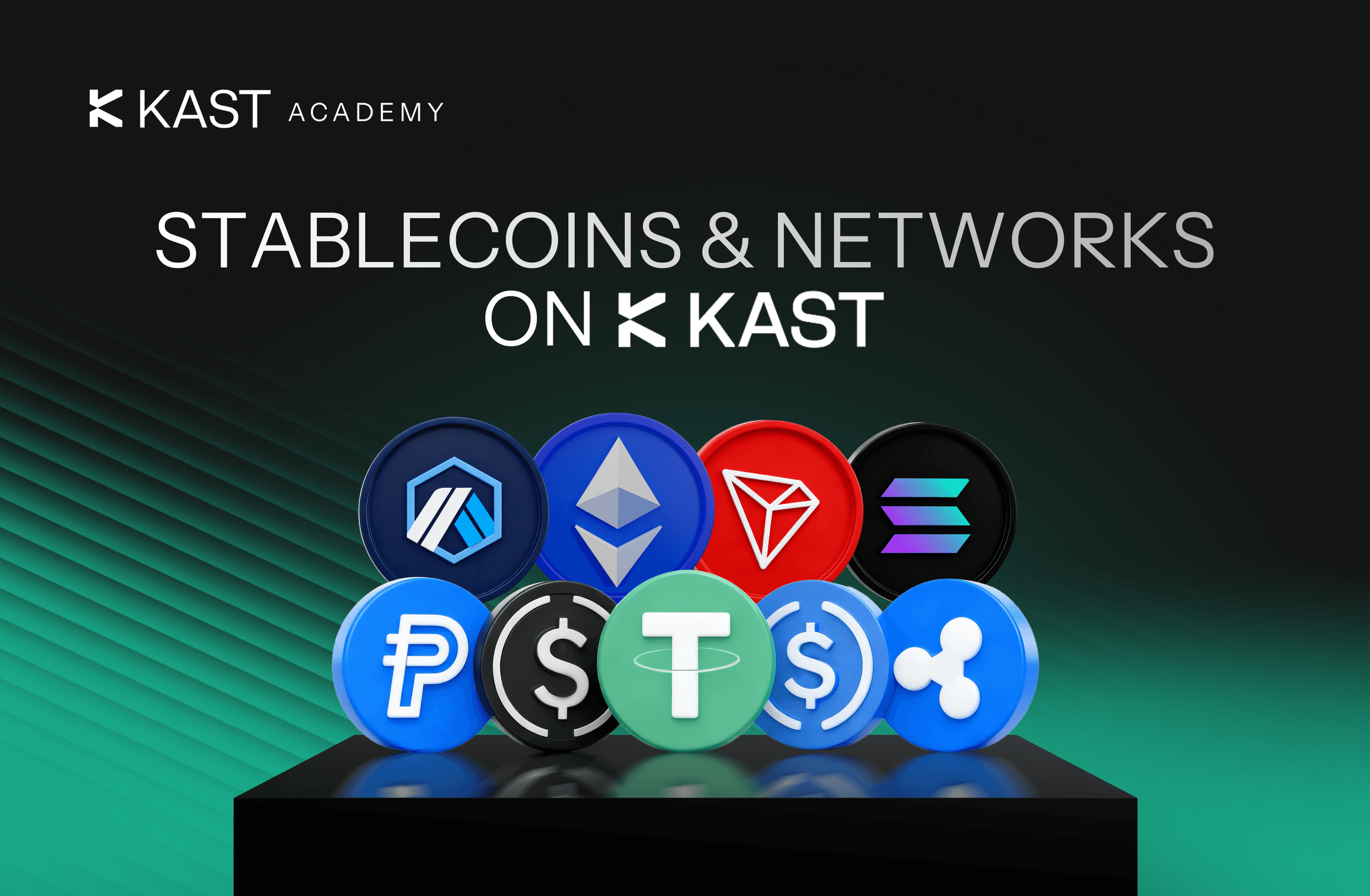
What Stablecoins And Networks Are Supported By KAST?
Did you know KAST supports stablecoins like USDC, USDT, PYUSD, RLUSD and networks like Solana, Ethereum, Polygon, Tron, BSC, and more? Learn how to choose the right network based on transaction fees, speed, and compatibility.
Key Takeaways
- Stablecoins define the value you move, while networks determine how fast and how cheaply that value travels.
- Transaction fees and speed vary by network, not by stablecoin, making network choice a key cost decision.
- KAST simplifies this by supporting multiple stablecoins and networks, letting you optimize for speed, cost, or compatibility.
KAST is the right place to manage your digital assets across trusted stablecoins and your favourite blockchain networks.
Whether you’re sending funds, paying for services or getting paid in USD, BRL, ARS, MXN, or many other currencies, KAST ensures fast, secure, and seamless transactions for you.
Why Stablecoins and Networks Matter for Your Finances
Let’s make this easy for you: Picking the right stablecoin and network is crucial to save money and move your funds faster.
We know it might seem too much to learn about blockchain networks, transaction fees, gas costs, and network compatibility. But, that is essential for making smart financial decisions when managing your digital money.
After a while, you will master it all.
What's the Difference Between Stablecoins and Networks?
Stablecoins are the what: the digital currency you're sending (like USDC or USDT), pegged to the US dollar for price stability.

- Market Cap
- Total Supply
- 24h Volume
- Peg
- Avg Deviation
- Collateral
- Cash + US Treasuries
- Governance
- Centralized
- Funds Freezable
- Yes
- Issuer
- Circle
- Jurisdiction
- United States
Live market data sourced from DefiLlama (opens in new tab) and CoinMarketCap (opens in new tab)
Networks are the how: the blockchain infrastructure (like Solana, Ethereum, or Tron) that processes your transaction, determining speed and fees.
Together, they work like this: the stablecoin is your currency, while the network is the highway it travels on. Different networks charge different "tolls" (gas fees) and offer different speeds for transporting the same stablecoin.
Understanding Transaction Fees Across Networks
Transaction fees (commonly known as gas fees) are the costs required to process and validate transactions on blockchain networks.
These fees are paid to network validators (which can be individuals or organizations running computer systems) who use their computational resources (specialized computer hardware and electricity) to secure and record your transaction on the blockchain.
Key factors that affect transaction fees:
- Network congestion: During high-traffic periods, fees increase as users compete for limited network capacity.
- Transaction complexity: Simple transfers cost less than complex smart contract interactions.
- Network architecture: Newer networks like Solana and Polygon use more efficient technology, so they can process transactions much faster and cheaper than for example, Ethereum's original mainnet.
- Speed preferences: Some networks allow you to pay higher fees for faster processing.
Understanding Network Compatibility for Stablecoins
Network compatibility refers to whether your wallet, exchange, or platform supports the specific blockchain network you want to use. Not all platforms support every network, which is why choosing the right combination matters.
Important compatibility considerations:
- Wallet support: Your receiving wallet must support the network you're sending on (e.g., sending USDC on Solana requires a Solana-compatible wallet).
- Address formats: Different networks use different address formats. Always verify the address format matches the network.
- Platform acceptance: Some exchanges or services only accept deposits on specific networks.
- Cross-chain limitations: Assets on one network can't automatically transfer to another without a bridge or conversion.
How to Choose the Right Network for Stablecoin Transactions
KAST makes it simple to choose the optimal network for your transaction. Let's look at a practical example:
Scenario: You want to send 100 USDC to a friend using KAST.
With KAST, 100 USDC arrives at the same value regardless of network, but your experience and costs vary significantly. KAST's platform displays these options so you can choose the best network for your needs.
When choosing a network for your 100 USDC transfer:
- For speed: Choose Solana (under 1 second, less than $0.01 fee).
- For lowest cost: Choose Polygon or Solana (both under $0.01).
Simply select your preferred network in the KAST app before confirming your transaction, and KAST will display the exact fee and estimated arrival time.
How to Know if My Local Currency Has a Stablecoin?
Most stablecoins are pegged to the US dollar, but there are also stablecoins tied to other major currencies like the Euro, British Pound, and Japanese Yen. Here's how to find out if your local currency has a stablecoin equivalent:
- Search cryptocurrency platforms: Check major exchanges like Coinbase, Binance, or Kraken to see if they list stablecoins pegged to your currency (e.g., EURS for Euro, GBPT for British Pound).
- Review stablecoin directories: Websites like CoinMarketCap or CoinGecko maintain comprehensive lists of stablecoins, including those pegged to various fiat currencies.
- Check with local crypto providers: Some regions have locally-issued stablecoins designed specifically for that market.
- Look for regulatory approval: In some countries, regulated financial institutions issue stablecoins tied to the local currency, which can be found through official financial news sources.
If your local currency doesn't have a widely-adopted stablecoin, you can still use USD-pegged stablecoins (like USDC or USDT) and convert them to your local currency through KAST or other exchange services.
What Stablecoins Are Supported by KAST?
KAST supports a wide selection of stablecoins to fit your needs and preferences:
- USDC (USD Coin): A regulated, transparent stablecoin backed 1:1 by US dollars held in reserve.
- USDT (Tether): Globally recognized and highly liquid, ideal for fast cross-platform transactions.
- USDCe (USDC Bridged): A bridged version of USDC used on certain networks for seamless compatibility.
- PYUSD (PayPal USD): A stablecoin issued by PayPal, designed for seamless integration with digital payments.
- RLUSD (Ripple USD): A stablecoin issued by Ripple, built for efficient cross-border payments and enterprise use.

- Market Cap
- Total Supply
- 24h Volume
- Collateral
- Cash, US Treasuries + Assets
- Governance
- Centralized
- Funds Freezable
- Yes
- Issuer
- Tether Limited
- Jurisdiction
- British Virgin Islands
- Launch Date
- 2014
Historical Incident: Tether has faced scrutiny regarding the full backing of its reserves.
Live market data sourced from DefiLlama (opens in new tab) and CoinMarketCap (opens in new tab)
What Are Networks in Web3?
In Web3, a blockchain network is the underlying infrastructure that processes and records transactions. Each network operates independently with its own rules, speed, and cost structure.
Think of networks as different highways for your digital assets. Some are faster, some are cheaper, and some are more widely supported by wallets and platforms.
Key differences between networks:
- Transaction speed: How quickly your transfer is confirmed (from seconds to minutes).
- Gas fees: The cost to process a transaction, which varies greatly between networks.
- Compatibility: Not all wallets and platforms support every network.
With KAST, you can choose the network that best fits your needs, whether you prioritize speed, cost, or compatibility with your existing wallet.
What Networks Are Supported By KAST?
To give users flexibility and low transaction costs, KAST supports multiple blockchain networks for stablecoin transfers.
Why KAST Supports Multiple Stablecoins And Networks
KAST believes in giving users choice, speed, and flexibility. Supporting multiple networks and stablecoins allows you to:
- Pick the best network for your wallet or transaction goals.
- Avoid high gas fees by choosing more efficient blockchains.
- Move funds between ecosystems without conversion issues.
No matter how you transact, KAST keeps it simple, reliable, and fast.
Get Your KAST Card Today
Now that you understand how KAST supports multiple stablecoins and networks, you can take the next step.
The KAST Card lets you spend your stablecoins, whether it's USDC, USDT, PYUSD, or RLUSD, across any of the networks KAST supports.
With the KAST Card, you can:
- Spend globally: use a credit line secured by your deposited balance.
- Shop anywhere: Use your card at millions of merchants worldwide, online and in-store.
- Earn rewards: Get rewarded on every transaction with KAST Points that you can use for future benefits.
- Maintain control: Manage your card directly from the KAST app with real-time notifications and spending controls.
Ready to bridge the gap between crypto and everyday spending?
Disclaimer: This content is provided by KAST Academy for educational purposes only and is not intended as financial advice or a recommendation to engage in any transaction. All information is provided "as-is" and does not account for your individual financial circumstances. Digital assets involve significant risk; the value of your investments may fluctuate, and you may lose your principal. Some products mentioned may be restricted in your jurisdiction. By continuing to read, you agree that KAST group, KAST Academy, its directors, officers and employees are not liable for any investment decisions or losses resulting from the use of this information.
Related articles
What Are Gas Fees and Why Are They So Cheap on Solana?
Gas fees are the cost of processing transactions on a blockchain. Some networks charge dollars or more per transaction, while others charge fractions of a cent. The difference comes down to how each blockchain is designed, and why Solana makes everyday crypto spending fast and cheap.
Can a Stablecoin Lose Its Value? Real Risks Explained
Stablecoins are designed to hold a $1 value, but history shows they can lose their peg. This guide explains how stablecoins work, why depegs happen, which designs are riskier, and how KAST decides which stablecoins to support.
Where Does Stablecoin Yield Come From?
Stablecoin yield comes from real onchain demand, borrowing, trading, and capital deployment, not inflation or promos. When demand rises, yields rise. When it falls, so does yield.