USDC vs. USDT vs. USDe: A Beginner’s Guide to the Best Stablecoin
A stablecoin can be great for trading and still be frustrating to spend. For everyday use, what matters most is stability under stress, fast and cheap transfers, wide support, and a clear risk profile. This guide compares USDC, USDT, and USDe through the lens of real-world spending.
Key Takeaways
- For everyday spending, network fees and speed matter just as much as the stablecoin itself.
- USDC and USDT are the simplest and most reliable options for most people.
- KAST turns stablecoins from a balance you hold into money you can actually spend in real life.
If you're using a stablecoin to spend, not just trade, your priorities change.
You're no longer optimizing for charts or yield alone. You are thinking about deposits that clear quickly, transfers that don't eat into small balances, and whether your money still works when markets get noisy.
That is where many “good” stablecoins start to feel frustrating.
This guide compares USDC, USDT, and USDe specifically as stablecoins for everyday spending. We'll keep it practical and focus on what actually affects day-to-day use.
If your goal is turning stablecoins into something you can use in real life, that is exactly what KAST helps you do.
Market Cap Comparison
| Stablecoin | Market Cap | Total Supply | 24h Volume |
|---|---|---|---|
 USDC#1 | |||
 USDT#2 | |||
 USDE#3 |
Live market data sourced from DefiLlama (opens in new tab) and CoinMarketCap (opens in new tab)
What “Best Stablecoin for Spending” Really Means
A stablecoin can be great for trading and still be annoying to spend. Yes, this happens a lot.
For everyday spending, four things matter most.
First, you want stability under stress. When markets get messy, you still want your balance to stay close to $1.
Second, you want cheap, fast transfers. Real spending includes deposits, top-ups, and small moves. On high-fee networks, those costs add up faster than you expect.
Third, you want wide support. It should work where you already are, across exchanges, wallets, and apps.
Finally, you want a clear risk profile. The more complicated the design, the more important it is to understand what could break when something goes wrong.
USDC vs USDT vs USDe for Spending: A Practical Comparison
Here is a simple side-by-side comparison focused on real-world spending, not trading.
We will break each one down in plain English below.
Why Use USDC for Everyday Spending?
USDC is designed to be boring, and that is the point.
People often choose USDC for spending because the reserves and reporting are easier to follow. USDC publishes regular reserve attestations backed by cash and US Treasuries, according to Circle’s monthly disclosures.
USDC is also supported across many networks, giving you flexibility to choose lower-fee options.

- Market Cap
- Total Supply
- 24h Volume
- Peg
- Avg Deviation
- Collateral
- Cash + US Treasuries
- Governance
- Centralized
- Funds Freezable
- Yes
- Issuer
- Circle
- Jurisdiction
- United States
Live market data sourced from DefiLlama (opens in new tab) and CoinMarketCap (opens in new tab)
Today, USDC runs on more than 30 blockchains and is accepted on more than 35 different exchanges.
For everyday payments, network fees and transaction speed often matter more than the choice of stablecoin.
Choosing a fast, low-fee network makes a real difference. Paying high fees for normal transactions gets old very quickly.
Sending $100 USDC with KAST costs about $1.10 on Solana, around $0.30 on Arbitrum, and roughly $6.10 on Ethereum.
Why Use USDT for Everyday Spending?
USDT is often the most common stablecoin in trading and transfers. For spending, the advantage is simple: you can usually find USDT wherever your money needs to go.
While its reserves and reporting have sometimes drawn more criticism than USDC’s, they remain robust overall. Even when USDT has briefly moved off $1, it has historically returned quickly during many market events.

- Market Cap
- Total Supply
- 24h Volume
- Peg
- Avg Deviation
- Collateral
- Cash, US Treasuries + Assets
- Governance
- Centralized
- Funds Freezable
- Yes
- Issuer
- Tether Limited
- Jurisdiction
- British Virgin Islands
Historical Incident: Tether has faced scrutiny regarding the full backing of its reserves.
Live market data sourced from DefiLlama (opens in new tab) and CoinMarketCap (opens in new tab)
USDT is currently supported on 13 blockchains. On fast networks, transfers can be very cheap. On congested networks, small payments can cost more than they should.
USDe for Spending: A Synthetic Dollar With Extra Complexity
USDe is not backed like traditional stablecoins.
The goal is to create a delta-neutral position. If the value of the collateral falls, the short perps should gain. If the collateral rises, the short perps lose, but the underlying collateral gains. In theory, this offsets directional price risk and helps USDe maintain a stable value around $1.
That design changes the risk you're taking, but also provides a significant yield when staking.
If your goal is simple, reliable spending, USDe can work, but it's not the easiest option.
It adds extra factors that matter most during stress, including hedging performance, derivatives liquidity, smart contract risk, and funding rates.
The yield is not guaranteed, and depends on numerous factors such as funding rate conditions, liquidity, counterparty, smart contract and protocol risk.
USDe is better treated as an advanced option, not a default spending balance.

- Market Cap
- Total Supply
- 24h Volume
- Collateral
- Crypto backing + delta-hedging derivatives positions
- Governance
- Semi-decentralized
- Funds Freezable
- No
- Issuer
- Ethena
- Launch Date
- 2024
Historical Incident: USDe is not fiat based, it relies on a delta neutral hedge design.
Live market data sourced from DefiLlama (opens in new tab) and CoinMarketCap (opens in new tab)
What Is the Best Stablecoin for Spending?
For most people, USDC or USDT is the simplest and most reliable choice.
The biggest advantage is flexibility. You can choose from multiple networks and pick a low-fee one.
It's also worth remembering that many “stablecoin fees” are actually network fees.
Sending funds on a high-fee network during congestion can be expensive, while sending on low-fee networks like Solana usually costs fractions of a cent.
Live market data sourced from DefiLlama (opens in new tab) and CoinMarketCap (opens in new tab)
For everyday spending, fast confirmation, low fees, and reliable uptime make a real difference.
If you want one default spending balance, USDC is usually the safest starting point when it is available on the networks you use. USDT remains a strong option in regions and platforms where it is the standard.
When USDC Is the Better Choice
USDC tends to make sense if you value clearer reporting, prefer a more transparent setup, and mostly use networks where USDC is well supported.
When USDT Is the Better Choice
USDT is often the better option if your money flows through markets where it is the norm, or if you care most about maximum reach and liquidity.
The Real Rule
For spending, the experience is shaped mostly by network fees, speed, and availability, not small differences between stablecoins.
How KAST Handles Stablecoins for Real-World Spending
To actually spend stablecoins in real life, you need more than just the asset itself. You need a product that turns stablecoin balances into payments without adding friction.
KAST is built for that final step.
It supports major stablecoins, including USDC, USDT, USDe, PYUSD, and RLUSD, with availability depending on the network you choose.
Costs You Should Expect
KAST does not charge a deposit fee for supported stablecoins. You only pay the blockchain network fee from the wallet or exchange you are sending from.
When sending stablecoins out of KAST, you pay the network fee, which varies by chain and is shown before you confirm, plus a fixed fee.
The biggest cost lever is still the network you choose. Low-fee networks like Solana, Polygon, Tron, BSC, and Stellar are usually cheapest, while Ethereum mainnet is typically the most expensive during congestion.
One edge case to note: if you deposit non-stablecoins, KAST automatically converts them into stablecoins and applies a conversion fee, which is shown in the app.
KAST-Supported Blockchains and Stablecoins
KAST’s supported networks vary by asset and by whether you are receiving or sending funds.
Receiving Stablecoins
Send Stablecoins
USDC can be sent on Solana, Ethereum, and Arbitrum.
USDT can be sent on Solana, Ethereum, and Tron.
Checklist Before You Send
Before sending funds, make sure your wallet or exchange supports the stablecoin on that specific network, choose a low-fee network when possible, and always match the network exactly.
Sending the right stablecoin on the wrong network is one of the easiest ways to lose funds.
Putting It All Together
For most people, USDC or USDT is the best stablecoin for spending.
USDC is usually the better choice if you prioritize transparency and reserve reporting. USDT often makes more sense if you prioritize liquidity and broad market acceptance.
USDe is worth considering only if you understand the added complexity and are comfortable with the trade-offs.
For day-to-day spending, low-fee networks matter just as much as the stablecoin itself.
Disclaimer: This content is provided by KAST Academy for educational purposes only and is not intended as financial advice or a recommendation to engage in any transaction. All information is provided "as-is" and does not account for your individual financial circumstances. Digital assets involve significant risk; the value of your investments may fluctuate, and you may lose your principal. Some products mentioned may be restricted in your jurisdiction. By continuing to read, you agree that KAST group, KAST Academy, its directors, officers and employees are not liable for any investment decisions or losses resulting from the use of this information.
Related articles
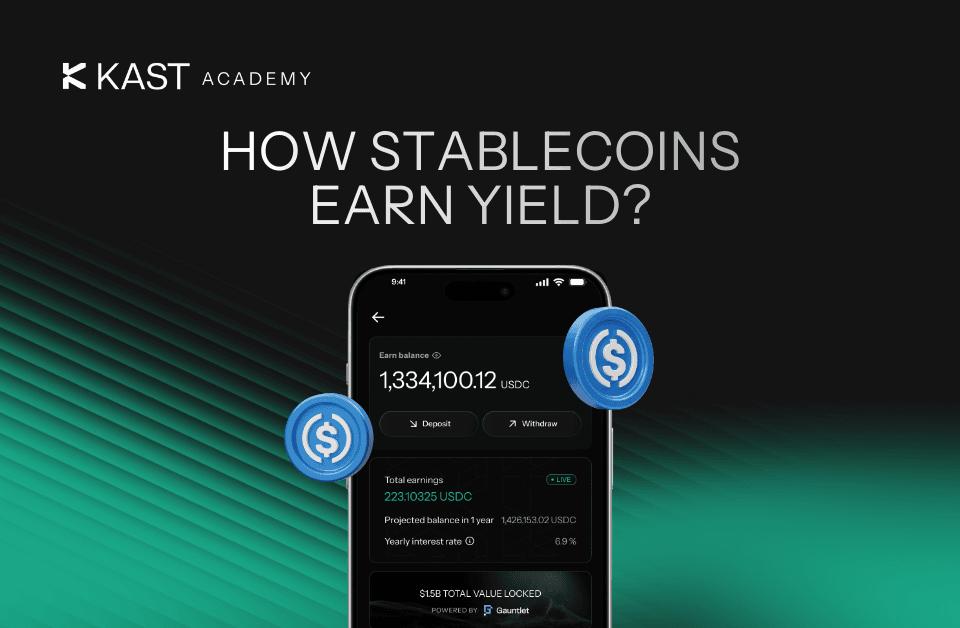
Where Does Stablecoin Yield Come From?
Stablecoin yield comes from real onchain demand, borrowing, trading, and capital deployment, not inflation or promos. When demand rises, yields rise. When it falls, so does yield.
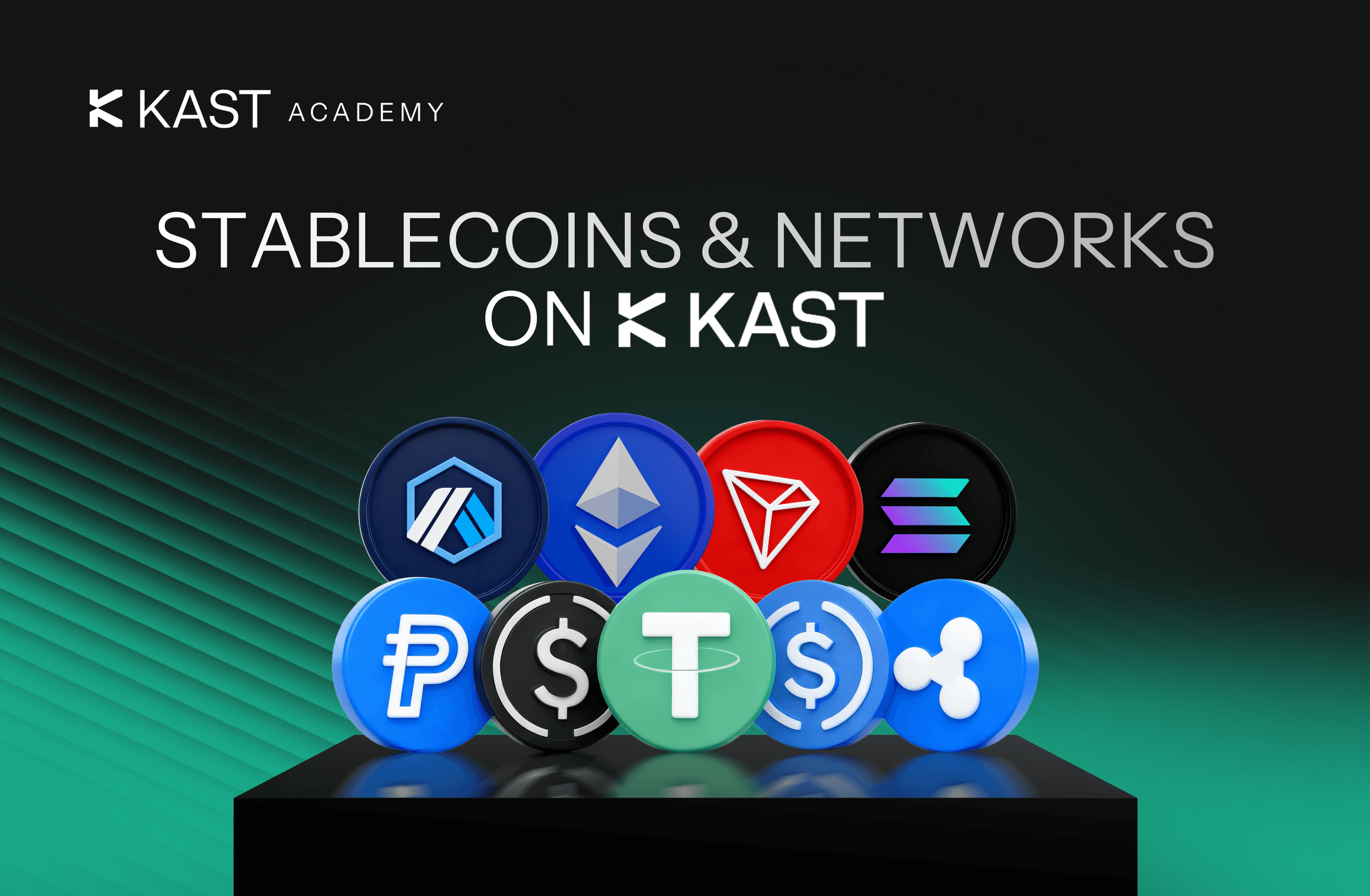
What Stablecoins And Networks Are Supported By KAST?
Did you know KAST supports stablecoins like USDC, USDT, PYUSD, RLUSD and networks like Solana, Ethereum, Polygon, Tron, BSC, and more? Learn how to choose the right network based on transaction fees, speed, and compatibility.
Can a Stablecoin Lose Its Value? Real Risks Explained
Stablecoins are designed to hold a $1 value, but history shows they can lose their peg. This guide explains how stablecoins work, why depegs happen, which designs are riskier, and how KAST decides which stablecoins to support.