Compound Interest: Do Daily Rewards Actually Add Up?
Daily rewards can look insignificant, especially when your balance only moves by cents. But that small change is where compounding starts: rewards added back into your balance increase the base for the next reward. Over time, repetition creates acceleration, even if growth looks flat at the start.
Key Takeaways
- Compounding is when rewards are added back, so future rewards are calculated on a slightly larger base.
- Early growth looks flat because the base is small, but repetition is what creates acceleration over time.
- If you’re earning yield through tools like KAST, the question is not just compounding, but where the yield comes from and what risks can interrupt it.
Daily rewards can look insignificant.
You check your balance. It’s up a tiny amount. You think, is this really doing anything?
Maybe it’s a few cents. Maybe it barely moves day to day. It doesn’t feel like progress, especially if you’re used to “real” financial changes showing up as obvious jumps.
That reaction is normal. Your brain notices sharp changes. It’s not great at noticing patterns that build quietly.
But that “tiny amount” is exactly where compounding starts.
And it’s also how products like KAST Earn are designed to work. Small rewards, added back in, building quietly over time.
What Compound Interest Actually Is
Compound interest means you earn returns on both your original amount and the rewards you’ve already accumulated.
There’s no hidden trick behind it.
Your rate does not increase.
Your base does.
If rewards are added back into your balance, the next reward is calculated on a slightly larger number. Over time, repeating that process is what creates acceleration, even if each individual day looks small.
This is why people call it “interest on interest.” Your earnings start generating their own earnings.
Why Small Gains Turn Into Something Bigger
Compounding doesn’t feel powerful at the beginning because the numbers are small and the changes are incremental.
Early on, growth looks flat.
Then it starts to bend.
Eventually, it becomes noticeable, because each step is built on the step before it.
The important detail is not the size of any single reward. It’s that every reward slightly increases the base for the next calculation.
That repetition is the whole engine.
Daily Reinvestment: Frequency Changes The Outcome
Compounding depends on how often rewards are reinvested.
Daily reinvestment means your balance updates every day, creating more compounding cycles over the same time period.
If two products offer the same underlying rate, compounding frequency can affect the final result. The difference may start small, and it can vary based on how and when rewards are reinvested.
This is also where APR and APY get confused:
- APR is the base rate without compounding.
- APY includes the effect of compounding over time.
In crypto, many platforms advertise APY, which assumes reinvestment is happening. More frequent compounding pushes your result closer to that number.
A Simple Example
Start with $1,000.
The loop looks like this:
- A reward is generated
- The reward is added to the balance
- The balance increases
- The next reward is slightly larger
At first, the difference is minimal.
Over time, the structure changes the outcome.
It’s not about earning more in a single day. It’s about earning on a slightly larger base, over and over.
What Can Go Wrong
Compounding is just math. Real systems add variables that change the result.
Yield is usually variable. If demand drops, the same compounding process produces smaller returns.
There is platform and protocol risk. If the system generating yield fails, pauses, or becomes unstable, the compounding loop can stop.
Liquidity can tighten during stress. A balance can grow on paper while access gets slower or more constrained when many people exit at once.
Asset risk still matters. If the asset you’re earning on drops in value, compounding can increase your exposure rather than offset it.
Compounding helps when the underlying yield is real, and the system keeps working as expected. It does not override those fundamentals.
Where KAST Fits In
KAST focuses on stablecoin yield, which generally comes from real activity like borrowing demand, trading fees, and capital deployment. That means returns are variable and reflect market conditions, not a fixed promise.
KAST Earn is built to simplify access to that yield. Instead of manually selecting protocols or constantly reinvesting rewards yourself, USD may be routed into a managed onchain strategy depending on eligibility and product configuration.
You might not see “payouts” landing like a paycheck. Instead, the compounding effect can show up as a gradually increasing Earn balance, which becomes most obvious over longer periods and when you withdraw.
The point isn’t that compounding is magical.
The point is that small, consistent reinvestment is how the math works, as long as the yield source and the system remain healthy.
Reinvesting Rewards
Compound interest is what happens when rewards start earning rewards.
Daily reinvestment increases how often that loop runs, which can change results over time.
But compounding isn’t the decision.
Understanding where yield comes from, what can break, and how easily you can access your funds matters more.
Because if those break, the compounding effect doesn’t matter.
Disclaimer: This content is provided by KAST Academy for educational purposes only and is not intended as financial advice or a recommendation to engage in any transaction. All information is provided "as-is" and does not account for your individual financial circumstances. Digital assets involve significant risk; the value of your investments may fluctuate, and you may lose your principal. Some products mentioned may be restricted in your jurisdiction. By continuing to read, you agree that KAST group, KAST Academy, its directors, officers and employees are not liable for any investment decisions or losses resulting from the use of this information.
Related articles
APR vs APY: What’s the Difference and How to Compare Returns
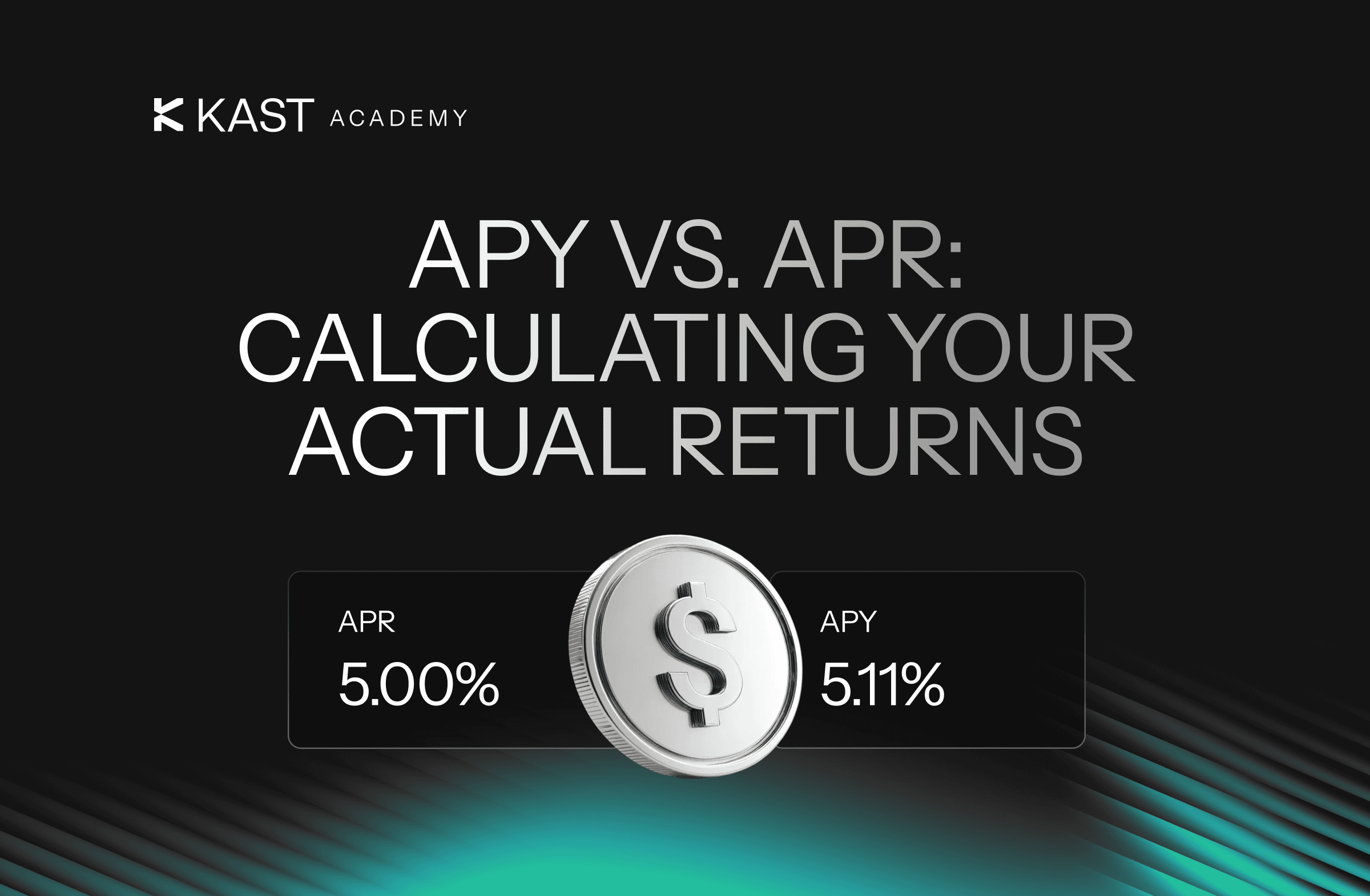
APR and APY often look interchangeable, but they measure interest differently. APR is the annual rate before compounding, while APY is the annual return after compounding is included. This guide breaks down the definitions, gives an example, and explains how these mechanics show up in KAST Earn.
What Is RWA Backing? Tutorial on How Treasury Bills Secure Your Yield
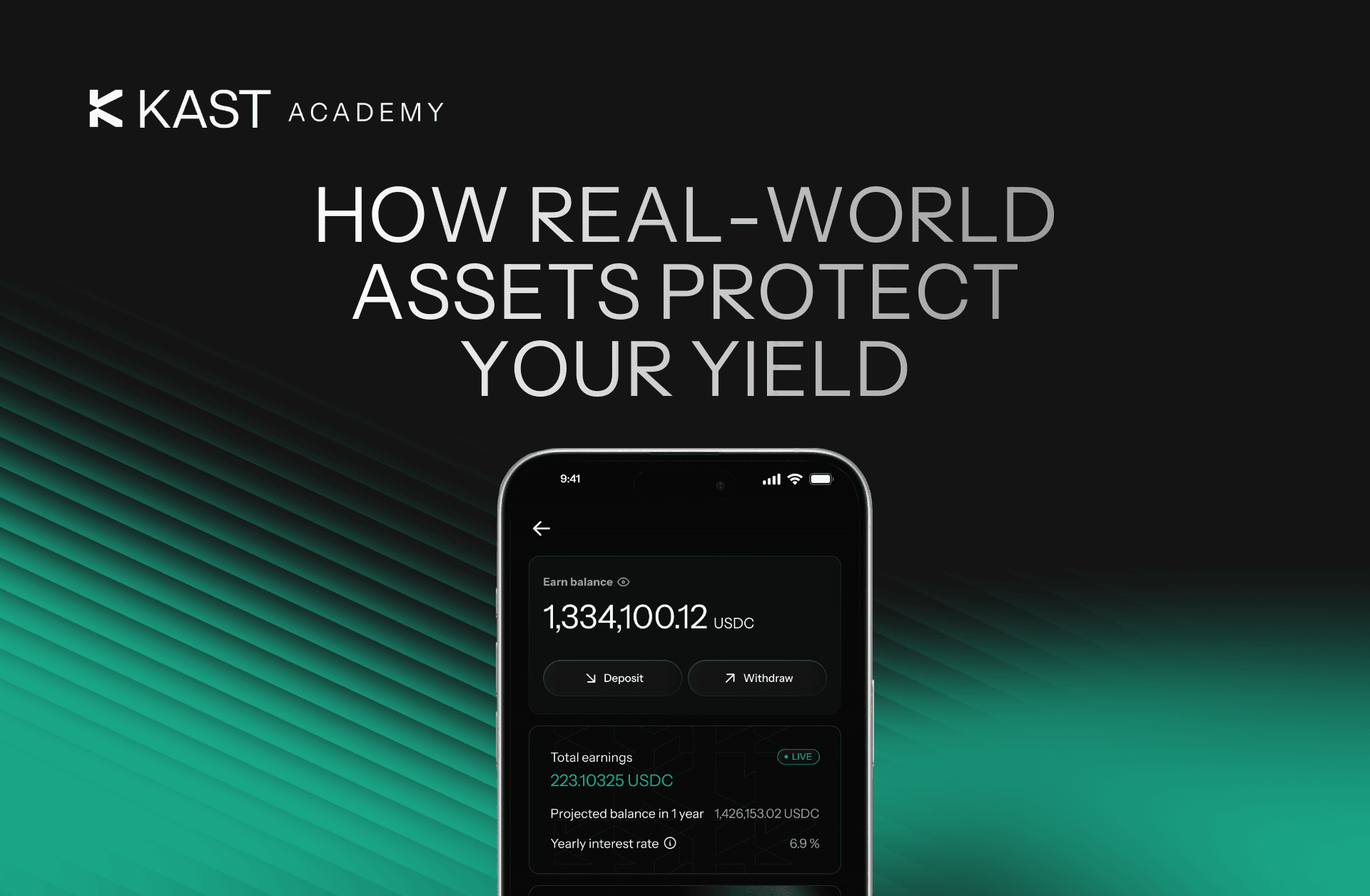
Real-World Assets (RWAs) bring familiar assets like U.S. Treasury bills and bonds onchain. RWAs let you earn yield backed by traditional financial instruments. This guide explains how RWA backing works, why it exists in crypto, and how KAST Earn uses it to help you generate steady yield.
Staking vs. Lending: A Beginner’s Guide to Safer Yield
Staking and lending can look similar in crypto, but they work for very different reasons. This guide breaks down how yield really works, what can fail, and how to choose the safer strategy for your situation.