What Are “Zero Fees” in Crypto: Every KAST Fee Explained
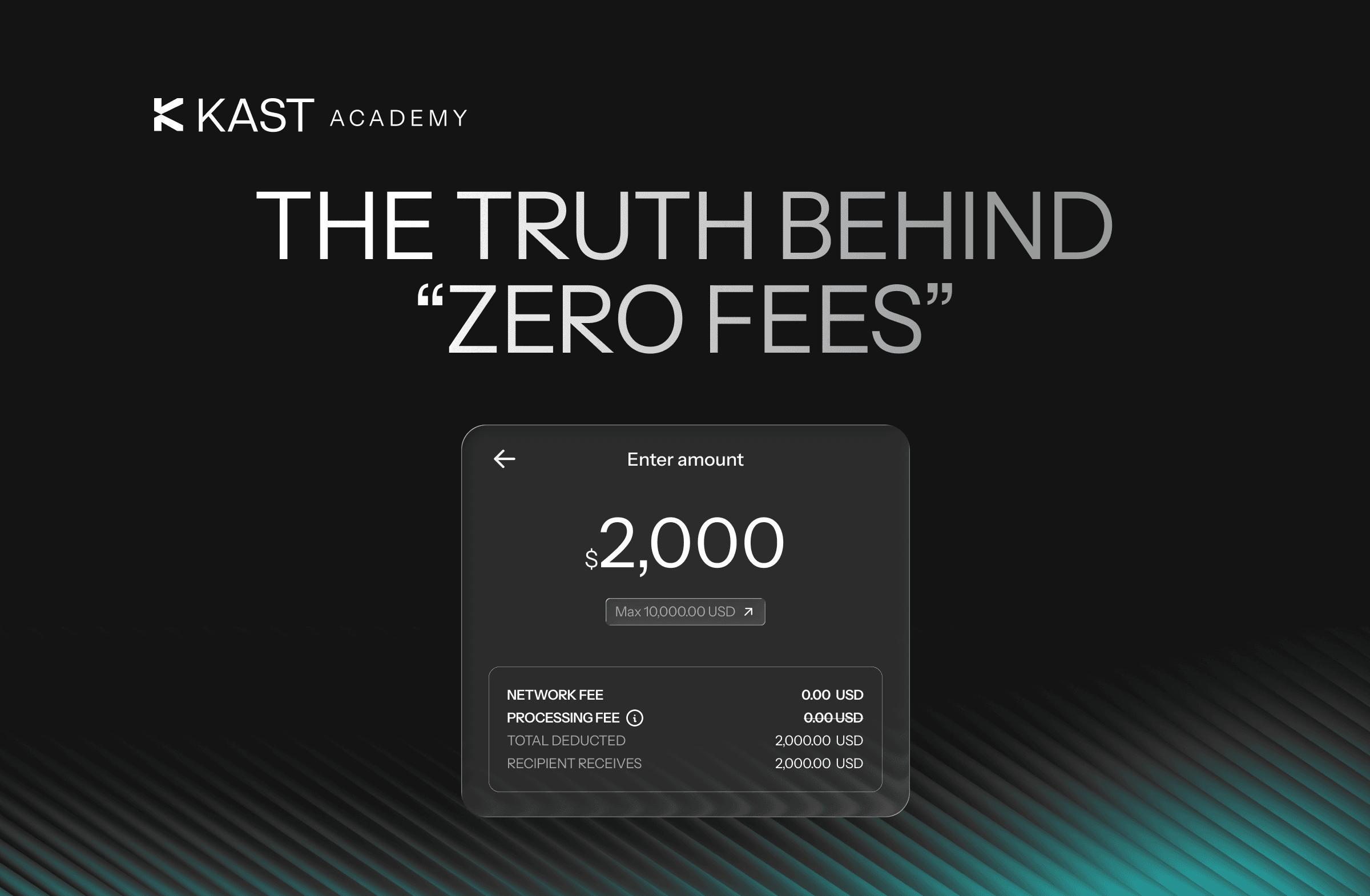
This guide breaks down how hidden crypto fees actually work, where spreads and markups quietly reduce your payout, and how KAST shows every fee upfront so you always know what you pay and what you receive.
Key Takeaways
- Most “zero fee” platforms still charge through spreads, exchange rate markups, or percentage-based costs that reduce your final payout.
- Hidden crypto fees usually appear in the exchange rate, stablecoin conversion, or last-step checkout screen rather than as a clear line item.
- KAST shows fees upfront, converts stablecoins 1:1 at spend with 0% spread, and lists fixed or clear percentage fees across funding, spending, and withdrawals.
You see advertisements for “zero fees”.
Then you send $1,000 and somehow receive less than you expected.
And now you’re staring at the screen wondering where the missing money went.
If that sounds familiar, you’ve come to the right place.
What you ran into are hidden fees: costs that do not show up as a clear line item, but still reduce what you get. And once you know what to look for, you start spotting them everywhere.
In crypto, these costs are rarely labeled clearly and usually appear as a spread vs fee difference, an exchange rate markup, or a built-in crypto conversion cost.
Let’s break it down properly. How do hidden fees actually work and how KAST sets itself apart by being transparent and upfront with all of its fees.
What Hidden Fees Really Are
Hidden fees are not always a secret charge designed to take your money.
Most of the time, they are one of these:
- A spread baked into the rate so you get a worse exchange rate than the “real” one.
- A markup baked into the asset price so “$1” of stablecoin is treated as less than $1 when you cash out.
- Fees that only shows up at the last step after you already committed.
- A percentage-based fee so costs scale up when you move bigger money.
The frustrating part is not just paying the fee, it's thinking you weren’t paying one.
A crypto spread is the difference between the real market exchange rate and the rate you are offered, and it is one of the most common hidden crypto fees.
Example: When 1 USDT Is Not Really $1
Here is a typical example: you withdraw USDT and the platform says there is “no fee".
Technically true. But the exchange rate used is not $1 = 1 USDT. That is a hidden fee.
This is a common issue with USDT withdrawal fees, where platforms advertise “no fee” but apply an exchange rate markup that lowers your payout.
In the KAST vs RedotPay comparison, USDT is effectively valued at $0.988 per USDT on withdrawal, which is a 1.2% embedded markup even when there are no fees in plain sight.
While this extra cost does not show up as a fee, it will reduce your payout in the end.
Example: When the Exchange Rate Changes at Checkout
Many off-ramps hide costs inside the exchange rate, but peer-to-peer platforms add another layer: user-set pricing and percentage-based fees that scale with transaction size.
On some P2P platforms, you're buying local currency from individual sellers who set their own prices. Extra charges, such as the 0.5% transaction fee on Naira P2P trading meaning larger transactions cost proportionally more.
Rates vary depending on the seller, payment method, and market demand, and the fee scales with transaction size.
How KAST Makes Fees Transparent
Let’s be clear. KAST has fees.
The point is that they are shown explicitly before you confirm the transfer.
KAST makes crypto card fees, stablecoin withdrawal fees, and FX charges clearly visible before you approve a transaction.
Also, KAST does two things that reduce hidden surprises:
- Stablecoin-to-USD conversion is 1:1 with 0% spread when you spend, with each purchase charged to your KAST Card credit line secured by your deposited balance.
- Fees are stated as fixed amounts or clear percentages across funding, spending, ATM, and withdrawals.
Let’s dive into the specifics.
Full Breakdown of KAST Fees
Card Spending
When you use your KAST card, fees depend on the currency and transaction size. Most everyday purchases have no extra costs.
USD purchases are completely free, and only non-USD transactions incur a 0.5-1.75% foreign exchange fee. There are no surprise charges for using Apple Pay or Google Pay, and most small transactions have no added costs.
ATM Withdrawals
If you need cash, here's what to expect. ATM fees are consistent at supported locations, combining a base fee with a percentage of your withdrawal.
Keep in mind the daily limits when planning cash withdrawals, especially if you're traveling.
Depositing Funds to Secure Your Credit Line
How much it costs to deposit funds that secure your KAST Card credit line depends on what you're depositing. Stablecoins are the most cost-effective option, converting at exactly 1:1 with no deposit fees. Other methods have varying costs based on the payment rail and asset type.
Stablecoin Deposits
Non-Stablecoin Tokens
USD Bank Transfers
Each funding method has trade-offs between cost, speed, and convenience. Stablecoins offer the best value, while traditional banking methods involve higher fees but may be more familiar for some users.
Withdrawals and Transfers
Cashing out or transferring funds depends on whether you're going onchain, to another KAST user, or to a bank account. The cheapest option is KAST Tag transfers between users (free and instant), while onchain withdrawals vary by network.
Solana is the most affordable at $1 + 0.1%, and Ethereum is the most expensive at $6 + 0.1%. For fiat withdrawals, costs depend on the destination currency and method, with USD local transfers being among the cheapest (0.5%, currently waived + ACH/Fedwire costs) and international wires costing more due to added fees.
Stablecoin Withdrawals (Onchain)
If you're comfortable with crypto, onchain withdrawals to stablecoins are often the fastest and cheapest way to move money out of KAST.
KAST Tag Transfers (Between KAST Users)
Sending money to other KAST users is the most efficient option. It has no fees and has instant delivery.
Bank Account Transfers (Fiat)
For international USD withdrawals over $5,000, the $30 fee is refunded until February 2026, though the 0.5% one remains.
Regional Payment Rails
These fees are clearly listed because they reflect real costs.
Costs Outside the App You Should Still Know About
Even with a transparent platform, there are costs that can exist outside the app:
- Intermediary bank fees on international wires
- Merchant-side pricing when you choose to pay in a different currency
- Network conditions on blockchains, such as high congestion periods can lead to higher fees.
The difference is that these are system-level realities, not product-level surprises.
Bottom Line
You should not have to do math to figure out where your money went.
Hidden fees are usually just spreads, markups, and last-minute add-ons wearing a “zero” headline.
The real cost of crypto often comes from exchange rate spreads, crypto off-ramp fees, and embedded markups rather than the advertised fee itself.
KAST is not “zero fees”, but has no surprises: clear line items, 1:1 stablecoin conversion at spend, and fees you can actually plan around.
If you are comparing platforms, screenshot the final “you pay” and “you receive” screen.
That is where the truth always shows up.
Disclaimer: This content is provided by KAST Academy for educational purposes only and is not intended as financial advice or a recommendation to engage in any transaction. All information is provided "as-is" and does not account for your individual financial circumstances. Digital assets involve significant risk; the value of your investments may fluctuate, and you may lose your principal. Some products mentioned may be restricted in your jurisdiction. By continuing to read, you agree that KAST group, KAST Academy, its directors, officers and employees are not liable for any investment decisions or losses resulting from the use of this information.
Related articles
Wise vs KAST: USD to PHP Fees, Rates and Transfer Comparison
If you earn in USD and cash out to pesos, fees can quietly take a bite. This breakdown compares KAST vs Wise for USD-to-PHP transfers, showing how each platform charges and how much PHP the recipient really receives.
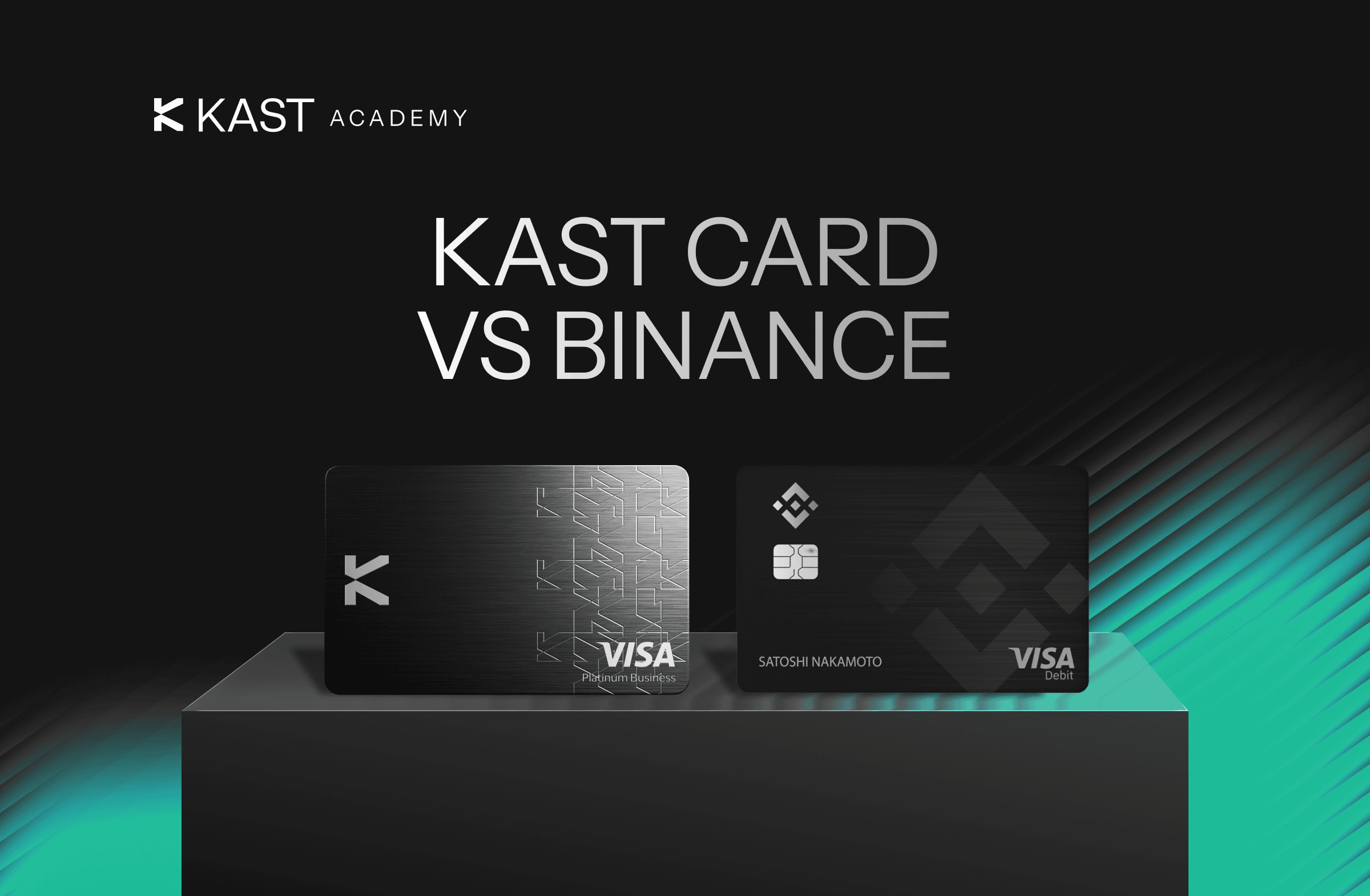
KAST Card vs Binance Card: Full Comparison for Crypto Spending
Wondering which crypto card actually fits how you spend? This KAST vs Binance Card comparison cuts through the hype to show how each card really works in day-to-day life. We break down fees, funding, rewards, and checkout experience so you can see what matters.
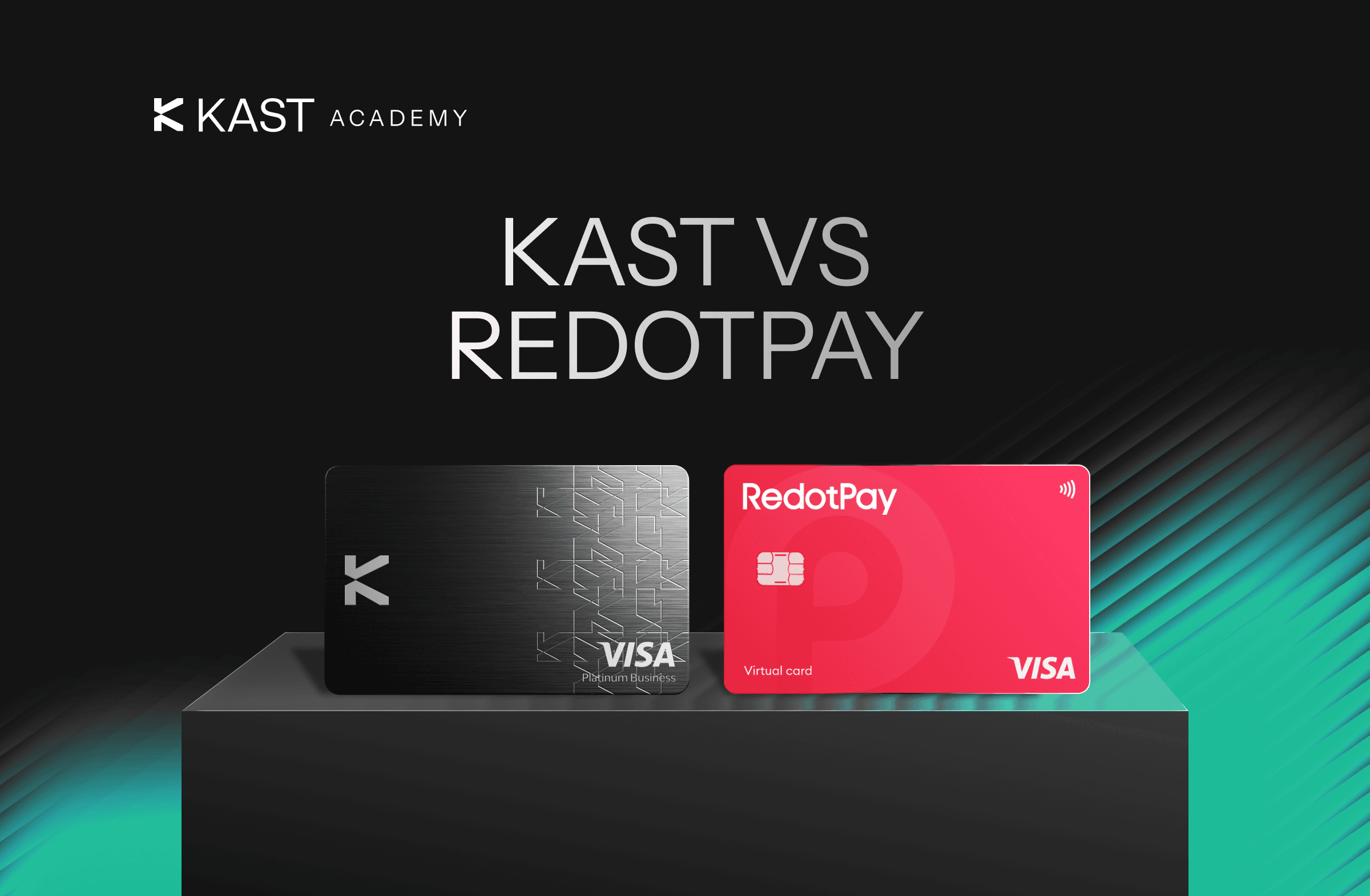
KAST vs RedotPay: Which Crypto Card Is Better for Everyday Spending?
A clear comparison of KAST vs RedotPay. See fees, cashback, limits, and real-world costs to choose the right crypto card for your spending.