USDC on Solana vs USDC on Ethereum (ERC-20): Key Differences Explained
USDC exists on multiple networks, including Ethereum (ERC-20) and Solana. While it’s the same stablecoin, network choice affects fees, speed, and compatibility. Here’s what changes and how to choose the right USDC network for your transfer.
Key Takeaways
- USDC on Ethereum (ERC-20) and USDC on Solana are the same stablecoin, but the network you choose affects fees, speed, and compatibility.
- Ethereum USDC typically offers broader ecosystem support, while Solana USDC usually provides lower network fees and faster transaction times.
- KAST supports USDC across multiple networks, allowing you to choose the option that minimizes fees and fits your transfer needs.
You’re trying to send USDC. Maybe you’re topping up an app. Maybe you’re just moving funds so you can actually spend them.
And then you get hit with: “Which USDC is this?”
You pause. Because USDC is USDC, right?
That’s what I assumed the first time, too.
But it’s a fair question. Solana USDC and ERC-20 USDC aren’t the same thing. Same stablecoin, different blockchain network, and that difference between USDC on Ethereum and USDC on Solana actually matters.
This is why comparing USDC on Ethereum vs Solana is not just technical; it directly affects your USDC network fees and transaction speed.
That’s also where KAST fits in. Not to overexplain it. Just to let you choose a route with clear fees and timing, so you can use your dollars instead of wondering why they haven’t arrived.
What Is USDC?
At its core, USDC is a digital dollar stablecoin. It’s designed to stay at a 1:1 value with the US dollar. It’s backed by dollar-denominated reserves and issued by Circle.
Most of the time, it behaves exactly how you want a dollar to behave.
It stays close to $1. It moves on blockchains. It’s supported by a lot of wallets, exchanges, and apps.
But here’s the detail that matters. USDC exists on multiple blockchains like Ethereum and Solana, which is why you’ll often see terms like “USDC on Ethereum” or “USDC on Solana".
If you remember one thing, make it this:
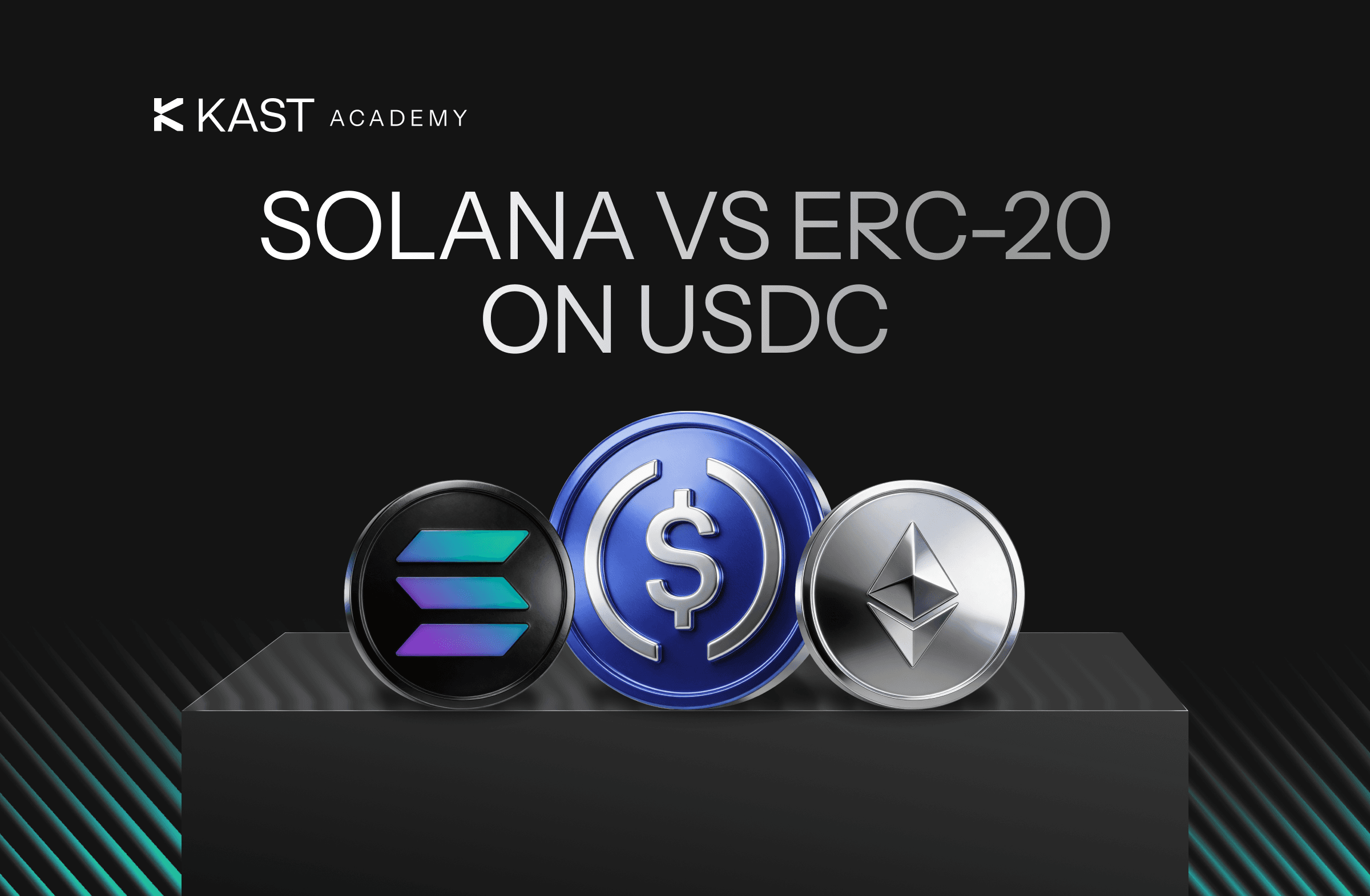
ERC-20 USDC and Solana USDC are the same stablecoin, just issued on different networks.
- On Ethereum, USDC is usually an ERC-20 token.
- On Solana, USDC is usually a SPL token.
Same issuer. Same backing. Different network processing your transaction.
And that changes fees, speed, and what can go wrong.

- Market Cap
- Total Supply
- 24h Volume
- Peg
- Avg Deviation
- Collateral
- Cash + US Treasuries
- Governance
- Centralized
- Funds Freezable
- Yes
- Issuer
- Circle
- Jurisdiction
- United States
Live market data sourced from DefiLlama (opens in new tab) and CoinMarketCap (opens in new tab)
What Is USDC on Ethereum (ERC-20)?
When someone says USDC on ERC-20, they mean USDC issued as an ERC-20 token on Ethereum.
Ethereum was USDC’s original home. A lot of liquidity and infrastructure still sit there.
It also has the highest total USDC supply, around $51 billion. So support across DeFi, exchanges, and wallets is strong.
Now for the practical part.
ERC-20 USDC runs on Ethereum. When Ethereum gets busy (it often does), USDC fees go up. For small transfers, that’s unnecessary.
Sending $20 and paying a noticeably high network fee? Yes, that happens.
What Is USDC on Solana?
USDC on Solana is native USDC issued on the Solana blockchain, using Solana’s SPL token standard.
Two big differences: it’s fast, and fees are usually a fraction of a cent.
Solana USDC fees are typically much lower than Ethereum network fees for the same transfer amount.
That’s why people often choose Solana USDC for everyday transfers. If you’re topping up, moving smaller amounts, or just don’t feel like paying extra for the same dollar, Solana USDC fees tend to be much lower.
Nothing dramatic about it. It’s just cheaper and quicker in most everyday cases.
Common USDC Network Mistakes
Here’s the part that confuses most people: most USDC issues aren’t about USDC itself. They’re about networks.
A few common mistakes:
- You pick the wrong network when withdrawing. You send “USDC (ERC-20)” to a Solana address. That usually doesn’t end well, and recovery isn’t guaranteed.
- Sending USDC on the wrong network is one of the most common crypto transfer mistakes, and recovery depends entirely on the receiving platform.
- You send a bridged token where native USDC is expected. Circle makes it clear that bridged USDC isn’t issued by them, and sending it to systems expecting native USDC can result in loss.
This is why two people can both say, “I sent USDC,” and have completely different experiences. One pays almost nothing and moves on. The other is opening support tickets.
Solana USDC vs ERC-20 USDC: Fees, Speed, and Network Differences
If you’re comparing Solana USDC vs ERC-20 USDC, the main differences come down to fees, speed, and ecosystem access.
Which USDC Network Should You Use? Ethereum vs Solana
If you want to move USDC cheaply and quickly, Solana USDC is often the easier choice.
If you’re staying inside Ethereum-based apps or DeFi, ERC-20 USDC is still the default.
Neither is objectively better. It depends on what you’re doing next.
The real question is: what do you plan to do with your USDC?
The right USDC network depends on whether you prioritize lower transaction fees or deeper Ethereum ecosystem access.
Using USDC with KAST: Fees, Networks, and Withdrawals
At this point, you already get it. The network determines the experience.
KAST is built to take that USDC balance and turn it into money you can actually use.
That includes spending with a card, where each purchase is charged to your KAST Card credit line and stablecoins are converted at checkout, and off-ramping to a bank through different payout routes, with fees and timing shown before you confirm.
KAST supports USDC across multiple networks.
So you can choose the one that makes sense for your transfer, instead of defaulting into higher network fees.
Here’s how the fees work:
- No deposit fee for supported stablecoins.
- You pay the network fee from the wallet or exchange you’re sending from.
- When sending stablecoins out of KAST, you pay the network fee (shown upfront) plus a fixed fee.
Network choice genuinely changes the cost. Choosing between USDC on Ethereum and USDC on Solana can significantly change your withdrawal fees.
On Solana, withdrawing $100 USDC with KAST is about $1.10. On Ethereum, it’s roughly $6.10.
Final Take: Choosing the Right USDC Network
You shouldn’t need to overthink this just to move a digital dollar.
So keep it simple:
- Double-check the network (Ethereum ERC-20 or Solana).
- Make sure the address format matches.
- If the destination expects native USDC, don’t send a bridged version.
- For smaller amounts, lean toward lower-fee networks when they’re supported.
USDC is the same stablecoin everywhere.
The key difference between USDC networks is how each blockchain handles transaction fees and settlement speed.
Pick the one that fits what you’re doing, check the details, and move on with your day.
Disclaimer: This content is provided by KAST Academy for educational purposes only and is not intended as financial advice or a recommendation to engage in any transaction. All information is provided "as-is" and does not account for your individual financial circumstances. Digital assets involve significant risk; the value of your investments may fluctuate, and you may lose your principal. Some products mentioned may be restricted in your jurisdiction. By continuing to read, you agree that KAST group, KAST Academy, its directors, officers and employees are not liable for any investment decisions or losses resulting from the use of this information.
Related articles
USDC vs. USDT vs. USDe: A Beginner’s Guide to the Best Stablecoin
A stablecoin can be great for trading and still be frustrating to spend. For everyday use, what matters most is stability under stress, fast and cheap transfers, wide support, and a clear risk profile. This guide compares USDC, USDT, and USDe through the lens of real-world spending.
What Stablecoins And Networks Are Supported By KAST?
Did you know KAST supports stablecoins like USDC, USDT, PYUSD, RLUSD and networks like Solana, Ethereum, Polygon, Tron, BSC, and more? Learn how to choose the right network based on transaction fees, speed, and compatibility.
Can a Stablecoin Lose Its Value? Real Risks Explained
Stablecoins are designed to hold a $1 value, but history shows they can lose their peg. This guide explains how stablecoins work, why depegs happen, which designs are riskier, and how KAST decides which stablecoins to support.