EUR Stablecoins in 2026: How They Work, Risks, Yield & USD Comparison
EUR-pegged stablecoins let you move euro value onchain without defaulting to dollars, but liquidity, regulation, and FX exposure still matter. This guide explains how they work, how they maintain their peg, where yield comes from, and how platforms like KAST handle euro conversions in 2026.
Key Takeaways
- EUR-pegged stablecoins aim to track €1 onchain, but they are smaller and less liquid than USD stablecoins.
- Under MiCA rules in 2026, euro stablecoins do not pay interest directly, so yield comes from DeFi platforms like Aave.
- Using USD stablecoins as a euro user introduces FX exposure, while platforms like KAST convert balances to USD and apply FX fees on non-USD spending.
If you live in Europe and get paid in EUR, crypto can feel unnecessarily dollar-centric. You open an app and see USDC, USDT, and other USD-quoted prices everywhere.
It’s normal to ask: "why am I converting my euros into a dollar stablecoin and then back again just to move value onchain?"
And yes, it’s fair to wonder whether that roundtrip quietly exposes you to FX costs you didn’t sign up for.
The good news: EUR-pegged stablecoins exist. They’re built to represent euro value on blockchains. They’re just smaller and less liquid than their USD peers.
Let’s break down what they are, why they’re hard to find, how they work, and what you need to know if you’re a KAST user.
What Is a EUR-Pegged Stablecoin?
A EUR-pegged stablecoin is a crypto token designed to maintain a price close to 1 euro per token. That’s the goal. It represents euro value inside a blockchain system. It’s not the legal euro, and the peg can move depending on market conditions.
When you hear “pegged,” it means the stablecoin is intended to stay around €1. In reality, markets are messy, and prices can drift slightly above or below.
The European Central Bank notes that euro stablecoins have shown more frequent and wider price deviations than large USD stablecoins in past observations. That’s mostly a liquidity issue, not a broken design.
Why EUR Stablecoins Feel Hard to Find
Euro stablecoins are real, but the ecosystem makes them less visible.
Exchanges and Decentralized Exchanges (DEX) usually list USD pairs first.
Liquidity clusters around USDC and USDT because that’s where most of the trading happens.
Banks and payment rails still operate on traditional timing and rules that don’t always align neatly with crypto markets.
So if you keep seeing dollar quotes and dollar stablecoins, it’s because that’s how the market actually runs, not because euro equivalents don’t exist.
The Most Used EUR Stablecoins in 2026
The euro stablecoin market is still small compared to USD stablecoins, but it’s becoming more structured and more regulated.
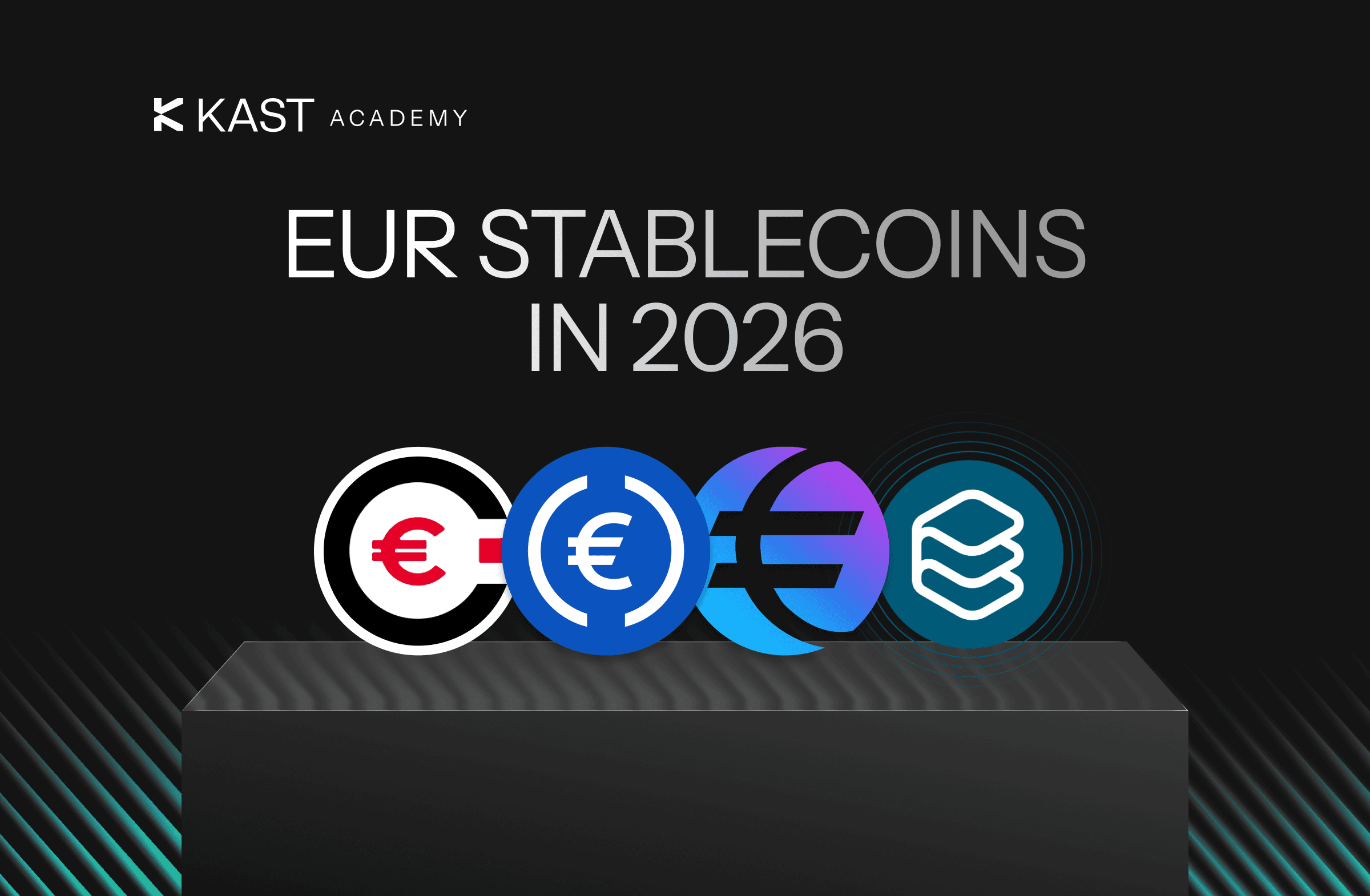
If you’re looking at serious EUR-denominated stablecoins today, these are the main names:
EURI (Eurite)
EURI is a euro-denominated stablecoin designed to be fully backed by euro reserves. For every token issued, an equivalent amount of euro-denominated assets is held in reserve.
EURI positions itself as infrastructure-ready euro liquidity for digital asset markets.

- Market Cap
- Total Supply
- 24h Volume
- Peg
- Avg Deviation
- Collateral
- Euro reserves held in regulated European banks
- Governance
- Centralized
- Funds Freezable
- Yes
- Issuer
- Banking Circle
- Jurisdiction
- European Union
Live market data sourced from DefiLlama (opens in new tab) and CoinMarketCap (opens in new tab)
EURC (Circle Euro Coin)
EURC is issued by Circle, the same company behind USDC. It is structured as a fully reserved, euro-backed stablecoin with reserves held in euro cash and short-term euro government instruments.
Because it mirrors USDC’s structure, EURC benefits from Circle’s compliance framework and integrations. Liquidity is growing, but it’s still nowhere near USDC’s scale. As of February 2026, EURC is issued on six chains.”

- Market Cap
- Total Supply
- 24h Volume
- Peg
- Avg Deviation
- Collateral
- Euro reserves held in regulated European banks
- Governance
- Centralized
- Funds Freezable
- Yes
- Issuer
- Circle
- Jurisdiction
- European Union
Live market data sourced from DefiLlama (opens in new tab) and CoinMarketCap (opens in new tab)
EURS (Stasis Euro)
EURS is one of the earlier euro stablecoins. It is fiat-backed, with reserves held in euro-denominated assets and supported by attestations.
Historically, EURS has experienced periods of slight depegging during thin liquidity conditions. That’s less about failure and more about smaller euro order books compared to USD markets.

- Market Cap
- Total Supply
- 24h Volume
- Peg
- Avg Deviation
- Collateral
- Euro fiat reserves held by financial institutions
- Governance
- Centralized
- Funds Freezable
- Yes
- Issuer
- STASIS
- Jurisdiction
- Malta
Live market data sourced from DefiLlama (opens in new tab) and CoinMarketCap (opens in new tab)
EURCV (Societe Generale CoinVertible)
EURCV is issued by Societe Generale-Forge, the digital asset arm of Societe Generale. It represents a more institutional version of a euro stablecoin.
EURCV is fully collateralized with euro reserves and issued within a regulated banking framework. It is primarily designed for institutional and professional participants rather than retail users.
These four represent the more structured segment of the EUR stablecoin market in 2026.

- Market Cap
- Total Supply
- 24h Volume
- Peg
- Avg Deviation
- Collateral
- Euro reserves held with regulated financial institutions
- Governance
- Centralized
- Funds Freezable
- Yes
- Issuer
- Societe Generale-Forge
- Jurisdiction
- France
Live market data sourced from DefiLlama (opens in new tab) and CoinMarketCap (opens in new tab)
How EUR Stablecoins Maintain Their Peg
All four stablecoins above follow a fiat-backed reserve model.
That means the peg mechanism is not algorithmic and not crypto-collateralized. It relies on traditional financial assets held against issued tokens.
Here’s how it works:
When euros are deposited with the issuer, new tokens are minted.
When tokens are redeemed, they are burned and euros are returned.
The peg’s stability depends on three factors:
- The quality and liquidity of the reserves
- Transparency and attestations
- The efficiency of the redemption process
Let’s look at each token.
EURI
EURI maintains its peg through full euro reserve backing. The issuer holds euro-denominated assets equal to the circulating supply. If EURI trades below €1, participants can buy tokens and redeem them for €1, pushing the price back toward parity.
EURC
EURC follows Circle’s established model. Reserves consist of euro cash and short-term euro government instruments. Transparency reporting supports the peg, and mint-and-redeem arbitrage keeps price aligned.
EURS
EURS uses fiat reserves held in euro-denominated assets. The peg is maintained through redemption rights and reserve backing. Price deviations can appear during thin liquidity, even if reserves remain intact.
EURCV
EURCV is fully collateralized with euro reserves and operates within a regulated banking structure. Its peg relies on formal redemption mechanisms and regulatory oversight, rather than purely retail arbitrage.
These are not experimental models. They are tokenized euro claims backed by traditional assets.
That doesn’t remove risk. It makes the structure easier to understand.
All aim for 1 EUR per token and rely on reserves.
Where they differ is liquidity and accessibility.
Where EUR Stablecoin Regulation Stands in 2026
Euro stablecoins operate under MiCA (Markets in Crypto-Assets Regulation).
The ECB’s 2025 Financial Stability Review highlights that euro-denominated stablecoins remain a small share of the overall stablecoin market, which is still dominated by USD-linked tokens. However, MiCA introduces stricter reserve, governance, and transparency requirements for issuers operating in the EU.
MiCA includes:
- Mandatory reserve backing requirements
- Disclosure and reporting obligations
- Oversight for significant asset-referenced tokens
- Capital and governance standards for issuers
The ECB emphasizes that stablecoins should not be considered risk-free assets and remain subject to liquidity, redemption, and confidence risks.
Regulation reduces uncertainty. It does not remove market dynamics.
Can EUR Stablecoins Gain Yield?
Under EU MiCA regulations effective in 2026, direct interest payments from stablecoin issuers are restricted, meaning yield must be generated through DeFi or other investment vehicles, not the token itself.
Some people try to seek yield by using third-party products such as DeFi lending protocols. In that model, users supply stablecoins to a lending pool, and borrowers pay interest to access that liquidity.
Rates can change quickly based on supply and demand. This is not risk-free. DeFi lending can involve smart contract risk, protocol risk, and liquidity risk. Even if the stablecoin price stays close to €1, you can still lose funds due to how the protocol operates.
On Aave, users deposit stablecoins into lending pools, and borrowers pay interest to access that liquidity. That interest becomes the yield for suppliers. For euro stablecoins like EURC, supply APYs have typically ranged around 3% to 4%, depending on utilization and demand.
Rates move constantly. When borrowing demand rises, yields increase. When liquidity is abundant, yields fall.
The token targets price stability. The yield comes from lending activity, which carries protocol and smart contract risk.
What Can Go Wrong
No stablecoin is immune to risk.
Peg Drift
Price can deviate from €1. On thin order books, even small trades can move price.
Issuer and Reserve Risk
You rely on reserves existing and being managed properly.
Liquidity Risk
Smaller markets mean wider spreads and more slippage.
Operational Risk
Send tokens to the wrong address or network, and funds can be lost.
Regulatory Risk
Rules can change how stablecoins are issued, used, or accessed.
EUR vs USD Stablecoins
If your goal is simply to move value or pay someone, here’s the practical difference:
USD Stablecoins (USDC, USDT)
- Deeper liquidity
- Wider exchange and platform support
- Tighter spreads
But if your goal is euro value, you carry EUR/USD exposure when converting back.
EUR Stablecoins (EURI, EURC, EURS, EURCV)
- Native euro value onchain
- Fewer FX layers if you truly want euro exposure
Trade-offs include smaller liquidity and fewer integrations compared to USD stablecoins.
Most people default to USD stablecoins because they’re easier to trade. That doesn’t mean they’re always the cleanest option for euro users.
KAST and EUR Stablecoins
As of February 2026, KAST does not natively support any EUR stablecoin as a listed funding asset. Your balance is treated in USD terms.
Deposits of supported stablecoins are converted to USD at a 1:1 rate with 0% spread under standard conditions when credited to your KAST account.
If you deposit euros, they are converted into USD value behind the scenes. That means you take on FX exposure if your goal was to remain in euro value.
On top of that, KAST applies foreign exchange fees on non-USD card transactions made with the KAST Card. According to KAST’s fee schedule, FX conversion fees typically range between 0.5% and 1.75%, depending on your region and transaction type.
There are no card fees on USD spending itself, but non-USD currency conversion costs still apply.
The fees are shown in the app before you confirm. You stay in control.
Final Thoughts
You don’t need to become an FX expert just to use blockchains.
EUR-pegged stablecoins exist so you can move euro value onchain without automatically stepping into dollar exposure.
They’re smaller than USD stablecoins, yes. But they’re real, regulated, and increasingly structured.
If you want to minimize unnecessary conversions:
- Choose a euro stablecoin with clear backing
- Check liquidity where you trade it
- Know how you plan to enter and exit
That’s it.
You move your money. You understand the layers. And you decide what exposure you’re comfortable with.
Disclaimer: This content is provided by KAST Academy for educational purposes only and is not intended as financial advice or a recommendation to engage in any transaction. All information is provided "as-is" and does not account for your individual financial circumstances. Digital assets involve significant risk; the value of your investments may fluctuate, and you may lose your principal. Some products mentioned may be restricted in your jurisdiction. By continuing to read, you agree that KAST group, KAST Academy, its directors, officers and employees are not liable for any investment decisions or losses resulting from the use of this information.
Related articles
USDC vs. USDT vs. USDe: A Beginner’s Guide to the Best Stablecoin
A stablecoin can be great for trading and still be frustrating to spend. For everyday use, what matters most is stability under stress, fast and cheap transfers, wide support, and a clear risk profile. This guide compares USDC, USDT, and USDe through the lens of real-world spending.
What Is Stablecoin Regulation and What Should You Know in 2026
Stablecoin regulation sets the rules for licensing, reserves, redemption, and reporting. This guide explains how major frameworks in the US, EU, Singapore, and Hong Kong shape stablecoin use and integration.
What Stablecoins And Networks Are Supported By KAST?
Did you know KAST supports stablecoins like USDC, USDT, PYUSD, RLUSD and networks like Solana, Ethereum, Polygon, Tron, BSC, and more? Learn how to choose the right network based on transaction fees, speed, and compatibility.