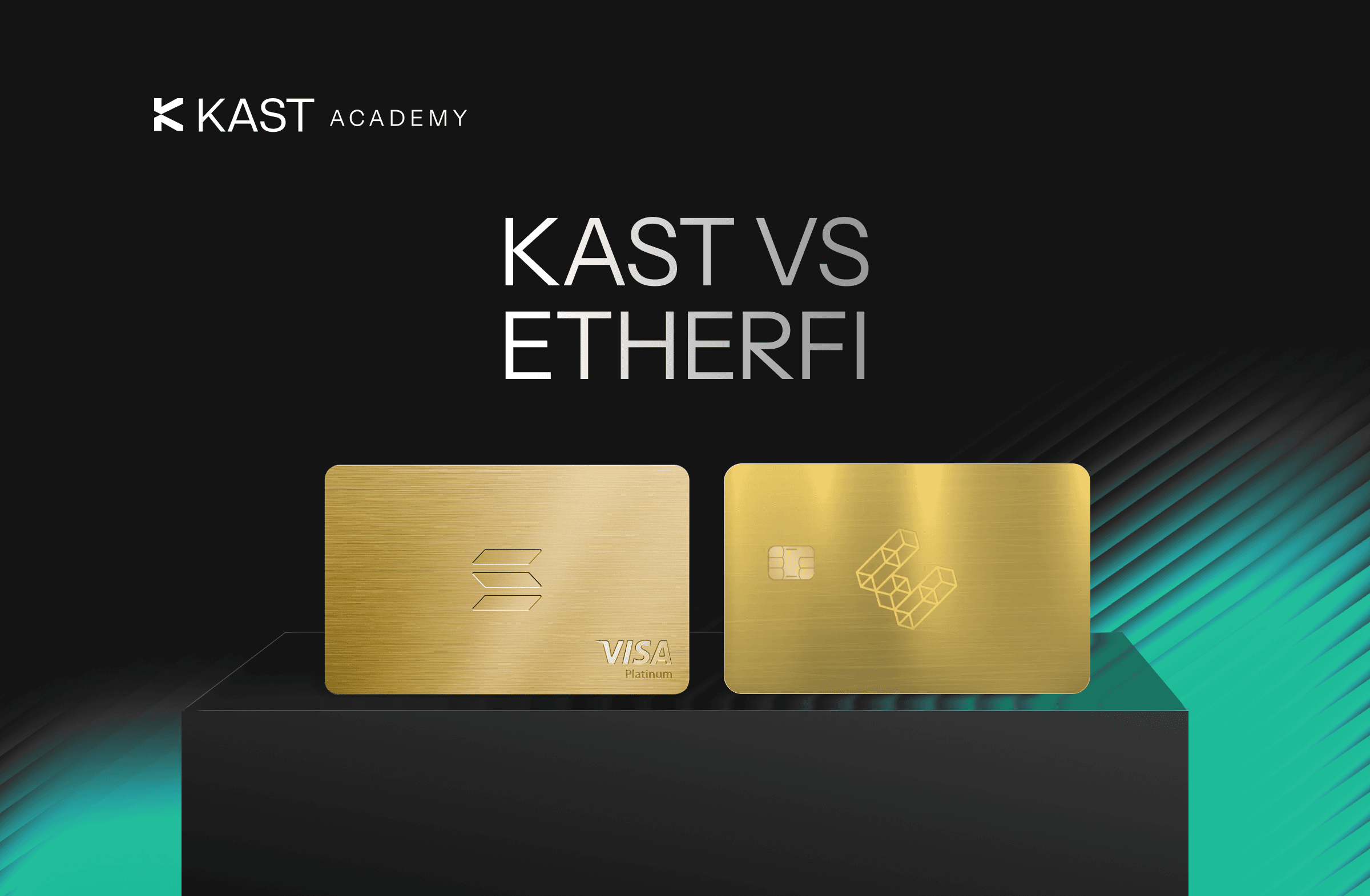
KAST vs EtherFi: Complete Crypto Card Comparison for 2026
KAST and EtherFi both let you spend crypto through traditional payment networks, but their structure, rewards, and fee models differ significantly. This 2026 comparison breaks down their design to help you choose the card that fits your spending style.
Key Takeaways
- KAST uses a USD balance model with predictable tier-based rewards, while EtherFi follows a non-custodial vault structure with ETH-denominated cashback.
- KAST relies mostly on fixed bank and withdrawal fees, whereas EtherFi applies percentage-based pricing across funding and off-ramps.
- The choice comes down to spending style: simplicity with KAST or DeFi-native control and wETH rewards with EtherFi.
You want to start using a crypto card, but you don’t know which one fits your spending habits better?
Both the KAST card and the EtherFi card let you use crypto for everyday spending. On the surface, they solve the same problem. Under the hood, they work very differently.
We’ll look at cashback, card costs, funding fees, withdrawals, FX charges, ATM access, and limits to show where they are similar and where they differ.
Whether you’re looking for a crypto card you can use daily without thinking about it, or you want a more decentralized finance (DeFi)-native way to spend crypto directly, here's how they compare in 2026.
KAST Card vs EtherFi Card
KAST and EtherFi both offer crypto cards connected to traditional payment networks. You can tap, pay online, withdraw cash, and use them like standard cards.
The key difference is not whether they work, but how they’re structured.
KAST is built around a USD balance model. You deposit stablecoins or fiat, which secure your KAST Card credit line and determine how much you can spend.
EtherFi is structured around a non-custodial vault model. Your funds stay connected to smart contracts, and rewards are paid in wETH.
If you’re choosing between them, the real question is whether you prefer a simpler experience or a DeFi-native setup.
Let’s break it down.
What is KAST Card?
KAST is a credit card issued through a licensed banking partner.
You deposit supported stablecoins or fiat, which secure your credit line and determine your spending limit.
When you pay, each purchase is charged to your KAST Card credit line, which is secured by your deposited balance.
There’s no unlock mechanic for basic spending. Once your account is funded, it works.
KAST offers multiple tiers that affect rewards, but the core spending flow stays the same across plans.

KAST Card
Card Fees
Limits
Fees
Funding Methods
Cashback + KAST Points
What is the EtherFi Card?
The EtherFi Card is positioned as a non-custodial card connected to EtherFi’s ecosystem.
Instead of converting to a traditional stored USD balance model, EtherFi uses a Smart Contract Vault structure. Funds remain connected to a Safe-based vault, and you retain control through a secure setup.
Rewards are paid in wETH, and cashback levels can depend on thresholds, referrals, and membership conditions.
The card is designed for users who want to stay closer to Ethereum-native assets while still accessing everyday payments.

EtherFi Card
Card Fees
Limits
Fees
Funding Methods
Rewards are paid in wETH
Cashback and Rewards: KAST vs EtherFi
Rewards are one of the biggest differences between these two cards.
KAST used tiered KAST Points. Your base reward depends on your tier, and the rewards can increase up to 6%.
EtherFi starts at 3% cashback up to a certain spending threshold. After that threshold, the rate decreases. Rewards are paid in wETH directly to your Cash account.
In specific categories, EtherFi advertises rewards up to 15% if unlocked through referrals or membership conditions.
These higher rewards depend on specific sector participation (such as restaurants) and unlock mechanics rather than automatic tier upgrades.
Rewards Comparison
If you prefer predictable rewards once you select your tier, KAST keeps the structure simple.
If you prefer ETH-denominated rewards and are comfortable meeting unlock conditions, EtherFi offers that route.
KAST vs EtherFi Card Pricing
Both platforms offer virtual cards without standard issuance fees. Differences appear with physical cards.
KAST does not charge for your first standard physical card, while EtherFi applies a flat $25 fee.
However, the $25 fee includes the shipping costs, which are not included in the KAST card.
For users who want a physical card immediately, that cost difference may matter.
Funding Fees for Each Crypto Card
Stablecoin deposits are the same on both KAST and EtherFi. Differences appear when you fund via bank transfers.
KAST uses fixed pricing for bank deposits. Whether you deposit $100 or $10,000, the ACH fee remains $2.
EtherFi uses a percentage-based structure, meaning larger deposits result in higher absolute fees.
If you regularly fund larger amounts, fixed pricing can be easier to forecast. If you fund smaller amounts, percentage fees may feel negligible.
Withdrawal & Off-Ramp Fees: KAST vs EtherFi
Off-ramping and withdrawals are where structural differences become clearer between KAST and EtherFi.
KAST supports local bank transfers, USD transfers, and global SWIFT payouts. Fees are clearly listed and mostly fixed.
EtherFi keeps withdrawals percentage-based and does not list a SWIFT option. This makes the structure simpler in percentage terms but more region-dependent.
If you need broader payout routes, KAST offers more flexibility. If you prefer percentage-based simplicity and primarily operate within supported regions, EtherFi keeps the structure straightforward.
FX and Transaction Fees for KAST & EtherFi
Both KAST and EtherFi offer 0% base currency spending. FX applies when spending outside your default currency.
KAST uses a variable FX fee depending on currency and network. EtherFi applies a flat 1% FX fee.
Neither platform layers additional merchant surcharges beyond FX, based on available documentation.
How ATM Limits Differ Between KAST and EtherFi
ATM limits for both KAST and EtherFi are almost identical in structure.
KAST includes a fixed $3 fee plus 2% per withdrawal. EtherFi appears to rely mainly on a percentage-based ATM fee.
For occasional cash access, the structures are similar. For frequent ATM users, the fixed $3 fee per withdrawal may slightly increase total cost on KAST.
For a comparison between KAST and RedotPay, click here.
Overall Structure: Custodial vs Non-Custodial
Beyond fees and rewards, the biggest structural difference is custody.
KAST uses a credit-based model where your deposited balance secures your spending limit. The experience mirrors a traditional payment card, with transactions charged to your credit line rather than deducted directly from your balance.
EtherFi positions itself as non-custodial and DeFi-aligned. Instead of holding your funds in a company account, EtherFi uses a smart contract vault (Safe) where you retain the private keys via a secure, biometric-linked enclave.
Rewards are paid in wETH, and the system is designed for users who want crypto-native exposure while still accessing traditional payment networks.
This difference affects how “traditional” or “crypto-native” the card feels in daily use.
KAST vs EtherFi: Which Card Fits Your Spending Style?
The better option depends on what you value most.
If you prefer predictable USD spending, fixed bank fees, clearly listed withdrawal routes, and tier-based rewards that do not depend on unlock mechanics, KAST may feel simpler to manage day to day.
If you prefer a non-custodial setup, ETH-denominated rewards, and deeper alignment with Ethereum-based participation, EtherFi may better match your workflow.
For everyday spending with straightforward fee structure and broader payout flexibility, KAST offers a more traditional experience.
For DeFi-native users who want ETH rewards and ecosystem integration, EtherFi is built around that use case.
Disclaimer: This content is provided by KAST Academy for educational purposes only and is not intended as financial advice or a recommendation to engage in any transaction. All information is provided "as-is" and does not account for your individual financial circumstances. Digital assets involve significant risk; the value of your investments may fluctuate, and you may lose your principal. Some products mentioned may be restricted in your jurisdiction. By continuing to read, you agree that KAST group, KAST Academy, its directors, officers and employees are not liable for any investment decisions or losses resulting from the use of this information.
Related articles
KAST Card vs Binance Card: Full Comparison for Crypto Spending
Wondering which crypto card actually fits how you spend? This KAST vs Binance Card comparison cuts through the hype to show how each card really works in day-to-day life. We break down fees, funding, rewards, and checkout experience so you can see what matters.
KAST vs RedotPay: Which Crypto Card Is Better for Everyday Spending?
A clear comparison of KAST vs RedotPay. See fees, cashback, limits, and real-world costs to choose the right crypto card for your spending.
Wise vs KAST: USD to PHP Fees, Rates and Transfer Comparison
If you earn in USD and cash out to pesos, fees can quietly take a bite. This breakdown compares KAST vs Wise for USD-to-PHP transfers, showing how each platform charges and how much PHP the recipient really receives.