KAST vs Bitget Card: How the Two Crypto Cards Compare in 2026
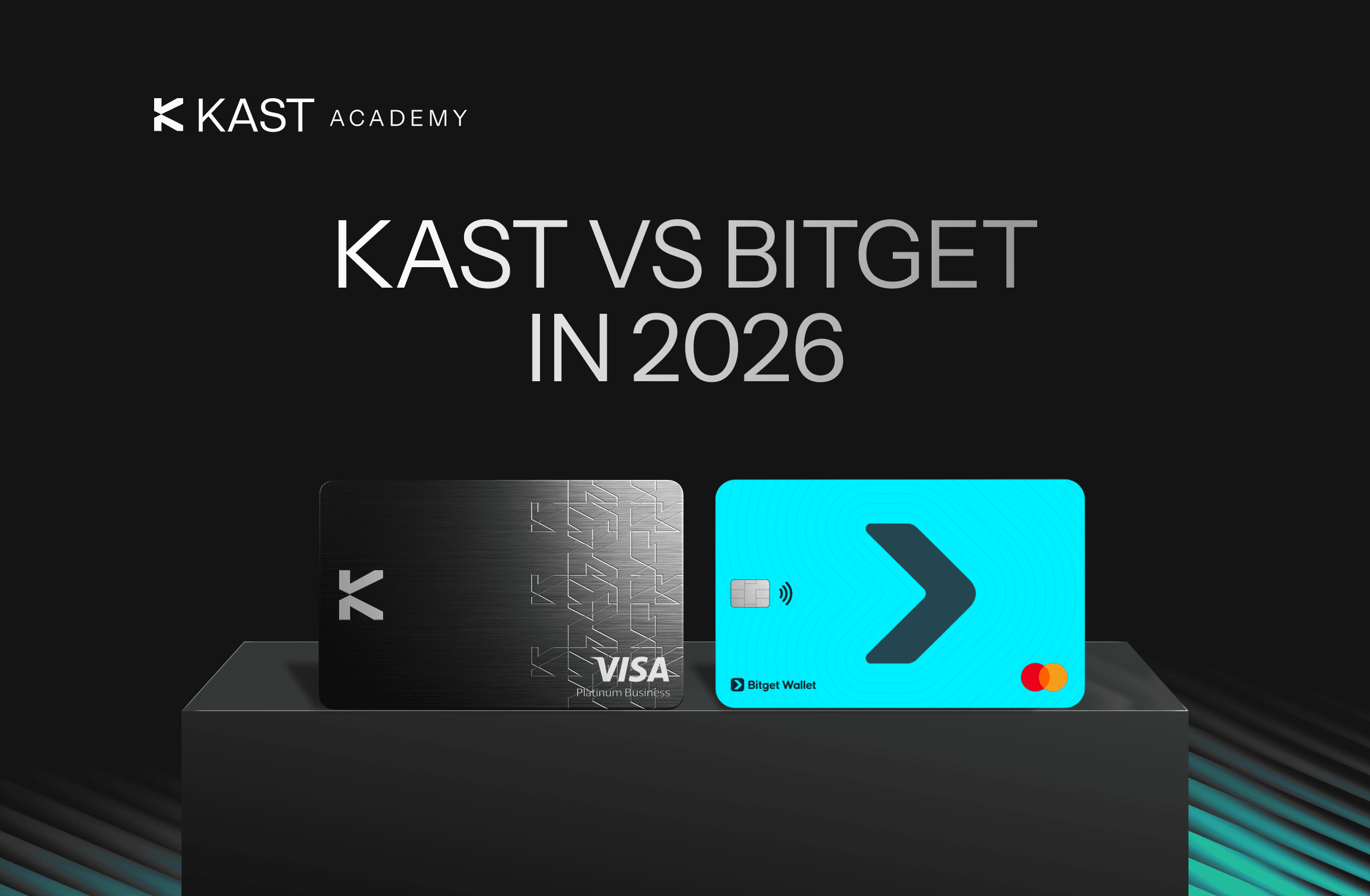
Choosing a crypto card is not just about where it is accepted. It is about how your balance is handled before you tap, and when your fees show up. This comparison breaks down KAST vs Bitget Card in 2026, focusing on per-purchase costs, FX charges, spending limits, and ATM rules.
Key Takeaways
- KAST works with a unified USD balance. You fund the account, your balance is treated in USD terms, and it determines your available credit limit.
- Bitget Card prioritizes exchange integration and scale, letting you spend USDT directly while supporting very high spending and ATM limits.
- The choice mainly comes down to payment flow: KAST works as a credit card with a credit limit tied to your deposited USD balance, while Bitget functions as a card connected directly to your exchange balance.
Want to figure out which crypto card fits your spending habits?
So let’s look at KAST vs Bitget Card. Both cards allow you to pay through regular card networks while your money starts in digital assets or stablecoins. Same basic idea. The details are where things get interesting.
The key differences lie in transaction fees, conversion fees, FX fees, balance handling, and spending limits. The small stuff that quietly changes how expensive or annoying a card becomes over time.
Below is a detailed breakdown of how the two cards compare in 2026, based on publicly available fee schedules and product documentation.
KAST vs Bitget Card: Crypto Credit Card Comparison
Both KAST and the Bitget Card let you spend crypto worldwide through a standard payment network. That part is simple.
What’s different is how your money moves before you tap the card.
KAST works more like a unified USD spending balance. You fund the account, your balance is treated in USD terms, and you spend from that balance.
Bitget Card is tied to your Bitget crypto exchange environment and your crypto holdings. Bitget states that the card lets you spend USDT directly from your OTC account, with fees and FX rules applied per transaction
This type of crypto card model is common among exchange-linked crypto cards, including options like the Bybit Card or Coinbase Card.
So yes, both cards let you spend crypto. The mechanics behind the payment are not the same.
What is KAST?
KAST is a crypto credit card where your deposited balance determines your available credit limit.
You fund the account. The funds become a USD-denominated balance that secures your credit line. When you spend, each purchase is charged to your KAST Card credit line.
No asset selection at checkout. No real-time conversion decisions. Just a single credit line backed by your deposited balance.
That means the payment experience tends to feel closer to traditional credit card used for everyday purchases.

KAST Card
Card Fees
Limits
Fees
Funding Methods
Cashback + KAST Points
What is the Bitget Card?
The Bitget Card is a crypto card connected to your Bitget account.
It pulls funds from your USDT balance in the OTC account, converting as transactions occur. Bitget also describes the structure as credit-card-like, though you still need sufficient funds for payments to go through.
So the card is tightly connected to the exchange environment. That has benefits. It also introduces more moving parts when a payment happens.
If you want a single USD spending balance, KAST leans that way.
If you want a card tied directly to your exchange funds and very high spending limits, Bitget is built for that use case.
Bitget Card
Card Fees
Limits
Fees
Funding Methods
Currencies, Funding, and How to Spend Crypto Directly
Let’s talk about what you’re actually spending when you use the crypto credit card for everyday spending.
In most cases, crypto cards work by converting the required amount of cryptocurrency into fiat currency at the moment of payment or shortly before the transaction settles.
With KAST, deposits convert into a unified USD balance that determines your available credit limit before you spend. That means you’re not deciding which asset to convert during checkout.
With Bitget, the card spends USDT directly from your OTC account. Bitget also notes something that surprises new users: the authorized amount can appear about 20% higher than the final settled amount until settlement completes.
If you want checkout totals that are easier to estimate, the prepaid USD balance model tends to be simpler.
If you prefer keeping funds inside an exchange environment and spending from there, Bitget is designed for that. It just comes with more mechanics behind the scenes.
KAST vs Bitget Crypto Credit Card Fees: Transaction Fees and FX Charges
Most crypto cards come with a few different fee layers. These can include purchase fees, foreign exchange costs, ATM withdrawals, and the spread applied when crypto is converted to fiat.
This is where the first differences between KAST and the Bitget Card show up:
KAST’s day-to-day costs mainly come from FX when you spend outside USD, because your credit line is based on a USD-denominated balance.
Bitget takes a different approach. Their schedule lists a 0.9% transaction fee on purchases, plus a 1% foreign transaction fee on top of Visa’s FX rate when you spend internationally.
Here is the full list of Bitget Card’s fees.
That per-purchase fee is the key structural difference, because it applies repeatedly across everyday spend.
Withdrawal Fees for KAST and the Bitget Card
Withdrawals are another area where the total cost depends on the fee model, not just the headline number.
KAST uses a combination of fixed fees plus FX.
Bitget’s structure is more variable for local bank payouts, with a clearly listed SWIFT cost.
Here is a full list of bank deposits and withdrawal fees for Bitget.
If you withdraw often, predictable fees are easier to plan around.
KAST vs Bitget Card Cashback Rewards: What Exists vs What’s Coming
Rewards are one of the main ways crypto cards try to stand out. Some offer cashback, others distribute platform tokens, and many tie higher rewards to premium card tiers.
Comparing KAST and the Bitget Card is a little uneven right now, because one rewards program is already live while the other is still described as “coming soon.”
KAST already runs a tier-based rewards system, with total rewards ranging from 1% to 6% through KAST Points.
Bitget has announced that users will receive BGB cashback, but the program is still described as launching soon.
If rewards matter to you today, KAST is easier to evaluate.
Bitget may become competitive once the cashback program fully launches and publishes its final rules.
ATM Fees and Limits for KAST and the Bitget Crypto Cards
If you withdraw cash regularly, ATM withdrawal fees, ATM fees, and ATM withdrawal limits matter more than people expect.
Bitget lists an ATM fee of $0.65 + 2% and publishes relatively high withdrawal limits.
KAST has the same 2% fee but a higher fixed fee of $3.
If you rely on ATMs frequently, Bitget clearly pushes higher limits.
If ATM use is occasional and your priority is predictable everyday spending, the funding and purchase-fee model tends to matter more than ATM max caps.
KAST vs Bitget Card Spending Limits: Everyday Use vs High-Limit Card Programs
Bitget publishes monthly spending limits up to $3,000,000 for Level 4 cardholders.
KAST does not set fixed limits on card spending, deposits or balances.
If you prefer not to think about monthly ceilings, KAST’s open spending structure may feel simpler.
If you want clearly defined high limits tied to account levels, Bitget publishes those thresholds directly.
Popular Crypto Cards in 2026
In 2026, the crypto card market is basically a tradeoff between convenience and control. Big exchange cards like Coinbase, Bybit, and Bitget work well if you already trade there and just want a card that works, even if it comes with conversion spreads or trading fees.
Newer options take a different approach. KAST is designed as a crypto credit card with a credit line backed by your deposited balance, while RedotPay is known for high spending limits and privacy. If you prefer self-custody, options like Ether.fi let you keep control of your keys until you spend.
There isn’t one “best” crypto card anymore. The right choice depends on what you want: cashback rewards, high spending limits, or simply paying with stablecoins.
When comparing cards, look at custody (custodial vs non-custodial), fees, rewards, and security. Conversion fees typically range from about 0.5% to 0.9%, though some cards charge more or hide costs in spreads. ATM policies, FX fees, and even inactivity fees can also affect the real cost.
Most cards include standard protections like PINs, 2FA, and the ability to freeze a lost card, and many require KYC. It’s also worth remembering that spending crypto can be a taxable event in some jurisdictions.
Should You Choose the KAST or the Bitget Card?
At the end of the day, the real difference is how the card handles your balance and spending flow.
KAST is built for people who want spending to feel like a straightforward credit card, with a credit line backed by a USD balance funded by stablecoins, with fewer fee layers during checkout and a defined rewards structure.
Bitget Card is designed for people who want spending tied directly to an exchange balance, along with a tiered system that supports very high transaction volumes.
As more popular crypto cards enter the market, the best crypto card for you will depend on how you prefer to convert crypto to fiat and manage everyday payments.
You are not just choosing which card is cheaper.
You are choosing which payment flow you want to repeat every time you tap.
Disclaimer: This content is provided by KAST Academy for educational purposes only and is not intended as financial advice or a recommendation to engage in any transaction. All information is provided "as-is" and does not account for your individual financial circumstances. Digital assets involve significant risk; the value of your investments may fluctuate, and you may lose your principal. Some products mentioned may be restricted in your jurisdiction. By continuing to read, you agree that KAST group, KAST Academy, its directors, officers and employees are not liable for any investment decisions or losses resulting from the use of this information.
Related articles
KAST vs EtherFi: Complete Crypto Card Comparison for 2026
KAST and EtherFi both let you spend crypto through traditional payment networks, but their structure, rewards, and fee models differ significantly. This 2026 comparison breaks down their design to help you choose the card that fits your spending style.
KAST vs Bybit Card: Which Crypto Card Is Better in 2026?
A detailed comparison of KAST and the Bybit Card covering FX fees, rewards, funding costs, ATM limits, and off-ramp structure to help you decide which crypto debit card fits your spending style.
KAST vs RedotPay: Which Crypto Card Is Better for Everyday Spending?
A clear comparison of KAST vs RedotPay. See fees, cashback, limits, and real-world costs to choose the right crypto card for your spending.