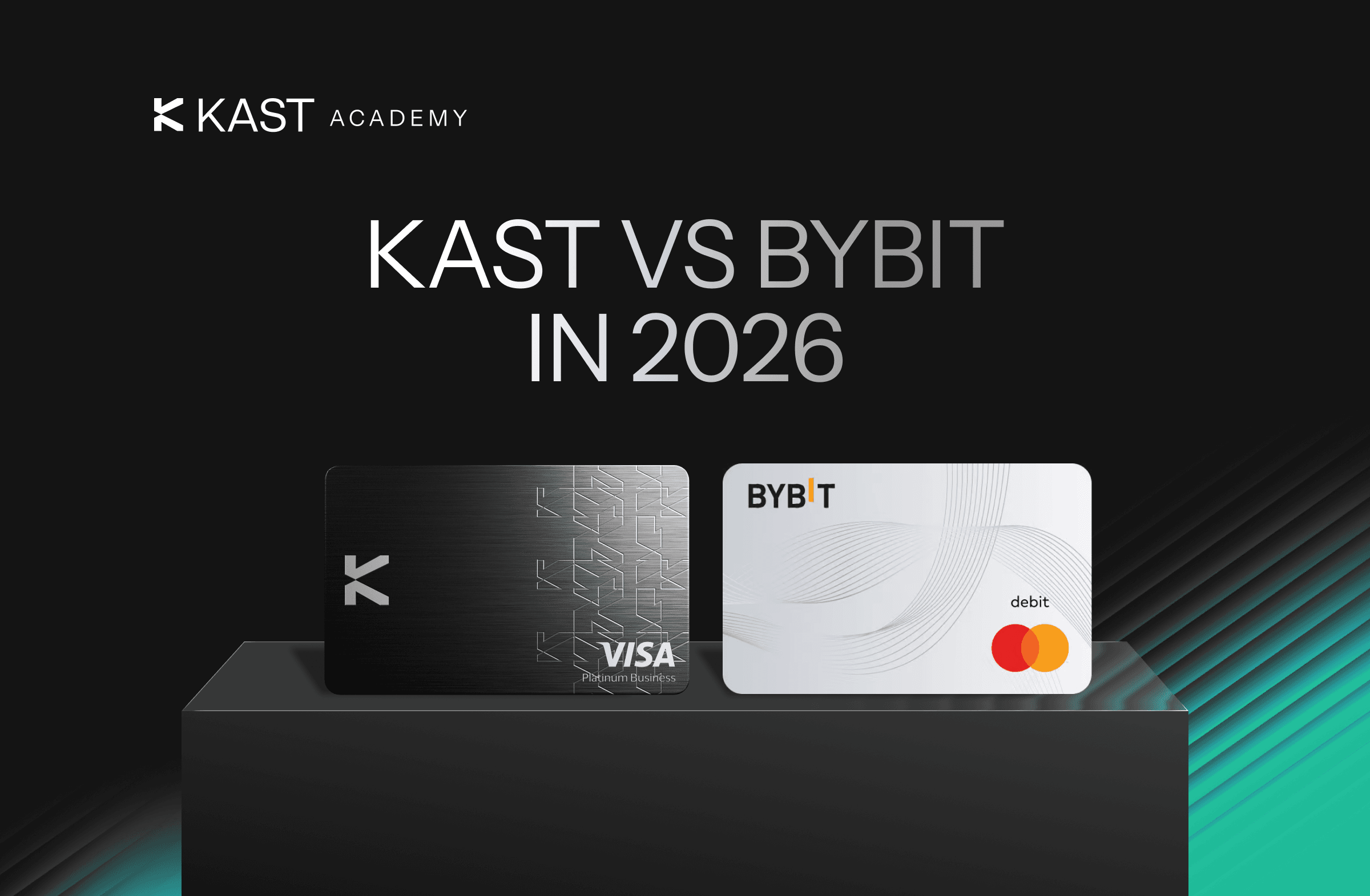
KAST vs Bybit Card: Which Crypto Card Is Better in 2026?
A detailed comparison of KAST and the Bybit Card covering FX fees, rewards, funding costs, ATM limits, and off-ramp structure to help you decide which crypto debit card fits your spending style.
Key Takeaways
- The KAST card and the Bybit Card follow different balance and fee structures, which affects how funding, FX, rewards, and withdrawals work in day-to-day use.
- KAST is built around a credit model where your deposited balance secures your spending limit, with tier-based rewards and clearly listed FX ranges.
- Bybit Card is tightly integrated with the Bybit exchange, offering VIP-tier structures and promotional cashback, but costs and limits can vary by region, campaign, and the asset used at checkout.
Trying to decide between KAST vs Bybit Card and which crypto card fits your spending habits?
This comparison looks at these two crypto card options that let you spend digital assets through a traditional card network.
On the surface, both solve the same problem: using your digital assets to pay at everyday merchants through a card network. Under the hood, they handle balances, fees, rewards, and withdrawals very differently.
We’ll compare card structure, cashback, funding fees, FX charges, ATM access, spending limits, and off-ramp costs to show where they overlap and where they diverge.
If you’re looking for a crypto card comparison in 2026, here’s how KAST and the Bybit Card compare in 2026.
KAST vs Bybit Card
KAST and the Bybit Card both let you spend crypto through a traditional card network, but they are built around two different spending flows.
KAST operates as a credit card with a spending limit secured by your deposited balance, while Bybit stays exchange-linked and can convert at the point of purchase.
That structural difference affects how fees apply, how balances move, and which spending experience feels smoother in day-to-day use.
What is KAST?
KAST is a credit card issued through a licensed banking partner.
You deposit supported assets, which secure your credit line and determine your spending limit.
When you make a purchase, it is charged to your credit line, with conversion handled during settlement rather than at checkout.

KAST Card
Card Fees
Limits
Fees
Funding Methods
Cashback + KAST Points
What is the Bybit Card?
The Bybit Card is linked to your Bybit account. If you spend non-fiat assets, conversion can occur at the time of purchase. Depending on region and card program, fees can include FX fees, crypto conversion fees, and possible FX padding that increases the authorization hold versus the final settled amount.
KAST may suit users that want spending to behave like a traditional credit card with predictable settlement and fewer variables at checkout.
Bybit may suit users that want to keep funds on the exchange and accept that costs can shift based on the asset you spend and your regional program.
Bybit Card
Card Fees
Limits
Fees
Funding Methods
Points are converted into USDT
Cashback, Rewards and Tier Benefits: KAST vs Bybit Card
KAST uses a structured tier system (Standard, Premium, Luxe). Rewards are tier-based and include KAST Points, with combined upside between 1% and 6% depending on tier.
Bybit uses VIP tiers and frequently promotes campaign-based cashback. Promotions can advertise up to 10%, but they are capped, time-limited, and region dependent.
If you want rewards that are easier to forecast month to month, KAST’s tier model is usually simpler. If you are willing to optimize around promos, Bybit can look stronger during active campaigns, but the effective rate depends on caps, timing, and eligibility.
KAST vs Bybit Card Fees: FX Rates, Crypto Conversion Fees, and Merchant Charges
Fee structure is where the two models diverge most clearly.
When comparing KAST fees and Bybit Card fees, the main difference is whether conversion happens before you spend or at the moment of checkout.
KAST charges 0% on USD purchases. For non-USD transactions, FX ranges from 0.5% to 1.75% depending on currency. There is no merchant-specific surcharge layer.
Bybit can apply an FX fee on top of the Mastercard FX rate. If spending crypto, a conversion fee may apply. Some regions such as Argentina include padding adjustments that temporarily increase authorization amounts.
KAST tends to feel simpler for international spending because FX is the main variable and conversion is not happening at checkout. Bybit can add more layers depending on the asset you spend and which card program applies to your region.
For users looking for a crypto card with lowest FX fees, predictability often matters as much as the headline rate.
Deposit and Funding Fees For KAST and Bybit
Both cards support crypto deposits without platform fees. Differences show up when using bank rails.
KAST uses fixed transfer fees. Bybit uses percentage-based fees for some routes and can apply minimums, depending on the rail.
If you fund mostly with stablecoins, both can be straightforward. If you fund from a US bank account, fixed fees can be easier to estimate as deposit size increases, while percentage fees can be more noticeable on larger transfers.
KAST vs Bybit Card Withdrawal Fees, Off-Ramp Costs and Bank Transfers
Withdrawal structure is another meaningful difference, where operational steps matter. With KAST, withdrawals are structured as direct payout routes with listed FX and fixed components.
With Bybit, funds typically move from the card back into the exchange wallet before being withdrawn through fiat rails. That extra step does not necessarily increase fees on its own, but it does add another layer to the process.
KAST supports local bank payouts and SWIFT transfers with stated FX and fixed components. There is no strict minimum withdrawal requirement.
Bybit supports fiat withdrawals through exchange rails, but fees vary by region and method. In many cases, funds move through the exchange withdrawal flow before off-ramping.
If you cash out regularly and want a predictable payout structure, KAST is usually easier to plan around. Bybit can be convenient if your region and rails are supported, but the effective cost depends more on the withdrawal method and eligibility.
ATM Fees and Spending Limits for KAST and Bybit
ATM and spending limits differ in structure.
KAST charges $3 plus 2% per withdrawal and limits ATM withdrawals to $750 per day through three transactions.
Bybit charges 2% per ATM withdrawal and offers structured daily and monthly limits that can scale with region and VIP tier.
If ATM access and higher monthly cash limits matter most, Bybit’s tier-based structure is generally more flexible.
If your focus is everyday card spending rather than frequent cash withdrawals, KAST’s model is more aligned with regular use.
KAST vs Bybit Card: Which Crypto Card Should You Choose?
KAST is built for people who want spending to feel like a traditional credit card, with a limit secured by deposited stablecoins or fiat. The prepaid balance approach reduces real-time conversion variables and can make total cost easier to estimate.
Bybit is built for people who already operate inside the exchange ecosystem and want spending tied directly to exchange balances, tier-based limits, and promo-driven rewards.
The core difference is not just cashback percentages, but whether you prefer a credit model secured by your deposited balance or an exchange-linked debit structure.
One prioritizes separation between conversion and spending. The other prioritizes integration with a broader trading ecosystem.
The trade-off is more variability depending on asset type, region, and card program.
If you want spending to feel closer to a traditional credit card with a secured spending limit, KAST may be the better option for everyday spending.
If you prefer keeping funds on an exchange and optimizing around tiers and promotions, Bybit may be a better fit, depending on your region and the exact program terms.
Disclaimer: This content is provided by KAST Academy for educational purposes only and is not intended as financial advice or a recommendation to engage in any transaction. All information is provided "as-is" and does not account for your individual financial circumstances. Digital assets involve significant risk; the value of your investments may fluctuate, and you may lose your principal. Some products mentioned may be restricted in your jurisdiction. By continuing to read, you agree that KAST group, KAST Academy, its directors, officers and employees are not liable for any investment decisions or losses resulting from the use of this information.
Related articles
KAST vs RedotPay: Which Crypto Card Is Better for Everyday Spending?
A clear comparison of KAST vs RedotPay. See fees, cashback, limits, and real-world costs to choose the right crypto card for your spending.
KAST Card vs Binance Card: Full Comparison for Crypto Spending
Wondering which crypto card actually fits how you spend? This KAST vs Binance Card comparison cuts through the hype to show how each card really works in day-to-day life. We break down fees, funding, rewards, and checkout experience so you can see what matters.
KAST vs EtherFi: Complete Crypto Card Comparison for 2026
KAST and EtherFi both let you spend crypto through traditional payment networks, but their structure, rewards, and fee models differ significantly. This 2026 comparison breaks down their design to help you choose the card that fits your spending style.