KAST vs Revolut: Full 2026 Comparison of Fees, Cashback, and Features
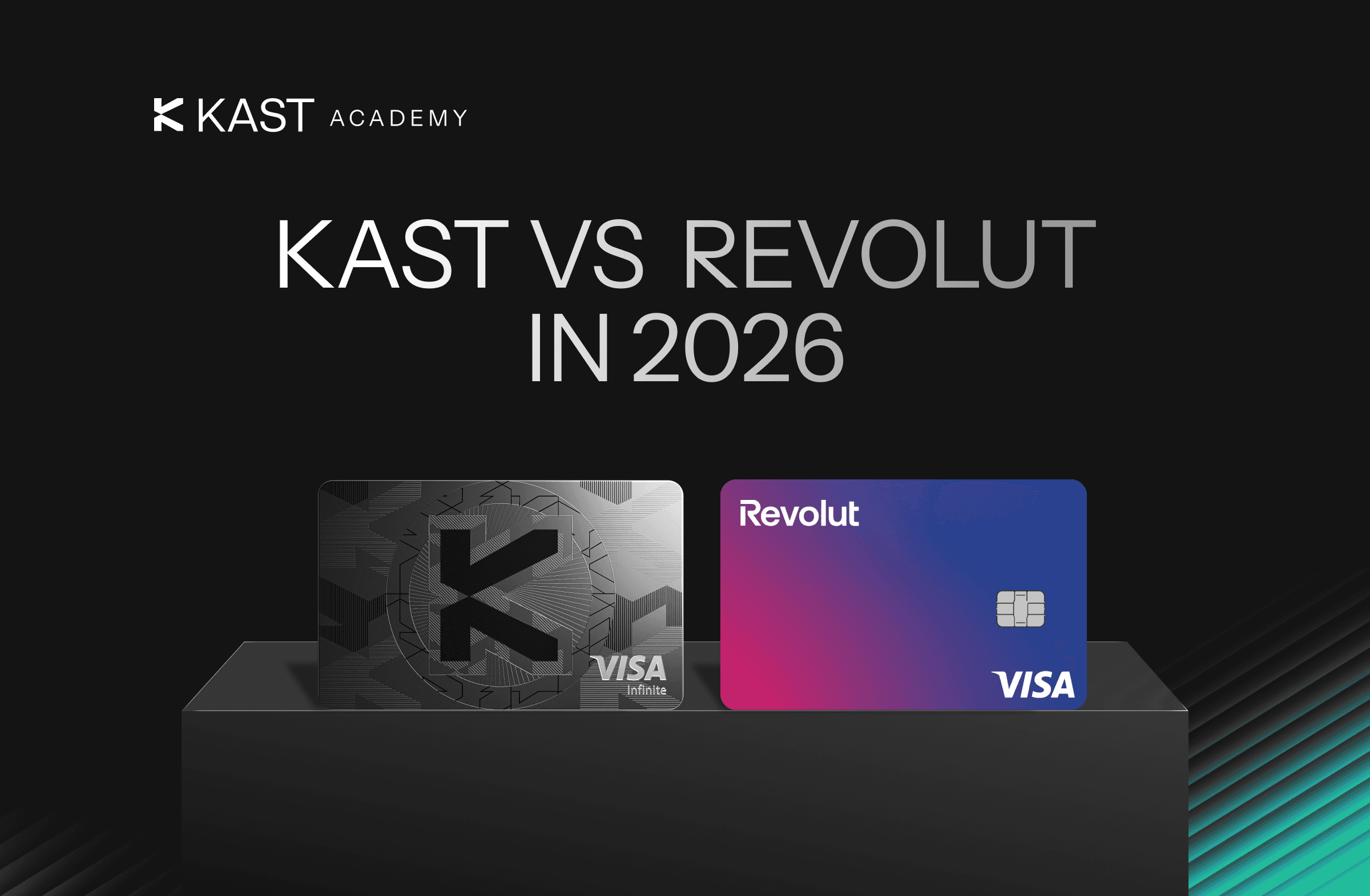
KAST and Revolut both simplify international spending, but they take fundamentally different approaches. KAST centers around a USD balance with predictable fees and higher rewards, while Revolut focuses on multi-currency flexibility with plan-based pricing that can vary depending on usage.
Key Takeaways
- KAST is built around a USD balance, with flexible funding options and rewards that scale by tier.
- Revolut pairs a payment card with a multi-currency account and app-based money tools.
- KAST gives you consistent, predictable pricing that’s easier to anticipate without tracking plan allowances, while Revolut rewards users who actively manage limits, timing, and tiers.
KAST and Revolut both aim to simplify spending across borders, but they do it with vastly different product models. KAST is designed around a USD balance, with stablecoin-friendly funding options.
You then spend via a credit card backed by that USD balance. Revolut, by contrast, functions best as a multi-currency account and finance app that includes a payment card linked to that account.
Because the foundations differ, the optimal choice often depends less on one headline fee and more on your typical flow of funds: whether you fund from stablecoins, from bank transfers, or from a multi-currency wallet you manage in-app.
KAST vs Revolut Card
KAST is designed around a USD balance with stablecoin-friendly funding, then layers a credit card backed by that balance with tiered rewards on top.
Revolut is a payment card linked to an account, with an emphasis on multi-currency support and transparent FX-style fee visibility in-app.

Revolut Card
Card Fees
Limits
Fees
Funding Methods
Cashback at the beginning of the month
The important practical difference is how “rules-based” your costs are. Revolut can be extremely competitive when you stay within plan thresholds, especially when it comes to FX and withdrawals, but that also means your effective costs can change as your monthly activity changes.
KAST’s positioning is more about stated fees you can predict without tracking allowances, and a solid amount of cashback.

KAST Card
Card Fees
Limits
Fees
Funding Methods
Cashback + KAST Points
What is KAST?
KAST is built for everyday spending with a USD balance and stablecoin-first funding in mind. It combines a credit card backed by that balance with tiered rewards, and frames its value around predictable fees, strong rewards upside, and wide international availability.
What is the Revolut Card?
Revolut provides a card tied to a Revolut account. It’s commonly used as a multi-currency wallet for international spending and transfers, with plan-based benefits and fees.
Revolut’s “best outcomes” often depend on the plan tier and the allowances that come with it (FX limits, ATM allowances, and other perks).
KAST vs Revolut Card Costs: Virtual, Physical, and Tiers
Card costs are similar at a baseline level, but differences show up once you factor in tiers, delivery, and how pricing scales with usage.
KAST lists a virtual card cost that’s free ($0–$2 in select countries) and a physical card cost that’s free (shipping extra). Revolut lists virtual cards as free, and for physical cards the first one is free (plus delivery), while higher-end plans can include card costs up to $50 for Ultra.
On tiers, KAST has Standard, Premium, and Luxe. Revolut has a 5-tier system.
Both KAST and Revolut offer free virtual cards and a free first physical card, so the entry point is similar. The difference shows up over time: Revolut’s pricing is more tied to plan tiers and allowances, while KAST keeps costs more directly tied to the card itself.
Card Type, Spending Model, and Funding Fees
If stablecoin funding is central to your routine, both KAST and Revolut list 0% fees for stablecoin deposits. The more relevant difference is how you move from funding into spending.
With KAST, the model is built around a USD balance that backs your available credit, where funds are ready for spending with clearly defined costs at the point of use.
Revolut, on the other hand, operates as a multi-currency account, where you hold and manage balances in-app and fund spending through that account.
In practice, KAST reads as a stablecoin-native spending product, where funding flows into a USD balance that backs your credit for spending. Revolut reads as a multi-currency account first, where spending is one part of a broader money management setup.
If you want a direct USD-based spending flow backed by your balance, KAST is more aligned. If you prefer managing multiple currencies and balances inside an app, Revolut offers more flexibility.
Rewards for KAST & Revolut: Cashback & Structure
Rewards are a major differentiator here. KAST has tiered rewards, with up to 6% maximum cashback.
Revolut offers cashback up to a maximum of 1%, paid at the end of the month.
The numbers tell a clear story: if your main objective is to earn meaningfully more back on spend, KAST is positioned as the higher-upside product.
Revolut’s rewards, in this dataset, read more like an added benefit rather than the core reason to choose the card.
If you want rewards to meaningfully change the economics of your everyday spending, KAST is the clearer fit on stated upside. If you care more about multi-currency banking utility and treat cashback as a bonus, Revolut’s value may still be compelling.
KAST vs Revolut: Deposits, Bank Transfers, and SWIFT Withdrawals
Moving money in and out matters as much as spending it, especially if you frequently use ACH, Fedwire, or SWIFT.
For USD deposits via bank transfer, KAST lists $2 for ACH and $15 for Fedwire. Revolut has free ACH deposits while Fedwire costs $10.
On withdrawals, KAST lists local bank withdrawal as $0–$3 + 1% FX, though some regions like Mexico have free withdrawals through SPEI.
Revolut offers free domestic transfers, as long as they are in the same currency. If the currencies do not match, FX fees will apply. For SWIFT, KAST lists $30 while Revolut lists $15–$50, depending on the bank provider.
Revolut looks stronger for users who primarily fund and withdraw through standard bank rails, especially with free ACH and sometimes free local bank withdrawals.
KAST vs Revolut: ATM limits
In ATM access, KAST lists $3 + 2% per withdrawal and a $750 daily limit (three withdrawals of $250 each).
Revolut lists ATM withdrawals as free up to £200–£2000 depending on tier, then 2% after that. The daily limit is $550 while the weekly one is $1,050.
A single ATM withdrawal abroad often combines two cost layers: the withdrawal fee and the FX conversion. That’s where the differences can add up.
KAST applies fixed, always-on pricing across both layers, so each withdrawal follows a consistent structure. Revolut, by contrast, ties both ATM and FX costs to plan allowances and timing.
This can make withdrawals very cheap within limits, but more variable once thresholds are exceeded or conversions happen on weekends.
If you withdraw cash occasionally and stay within plan limits, Revolut can be highly efficient. If you want predictable costs per withdrawal without tracking allowances, KAST’s structure is easier to follow.
Yield Comparison for KAST & Revolut
Both KAST and Revolut let your idle balance earn yield. The difference is where the yield comes from and how it behaves.
Revolut offers yield through savings-style products and cash funds, with rates that look and feel like traditional finance.
KAST’s Earn product is built around onchain stablecoin yield, where returns come from real activity: borrowing demand, trading fees, and capital allocation.
KAST yield moves because markets move. When demand for stablecoins is high, rates go up. When demand drops, rates go down. The APY is variable and stood at 4.83% as of April 2026.
Revolut is more rate-based and plan-driven. You get a clearer headline number, but it’s tied to product type, tier, and region. As of April 2026, the APY for USD is 3.45% and the APY for EUR is 1.85%.
Revolut also offers a high-yield savings account with yield up to 5.50%, available to high tiers such as metal.
If you want yield that behaves like a savings account, Revolut fits.
If you want yield that tracks market demand and can push higher returns, KAST is built for that.
Final Verdict: Which Card Fits Your Daily Spend?
KAST is the better match if your priorities are higher stated rewards upside that scale with tier usage. It’s positioned for people who want everyday spending to “pay them back” in a meaningful way, and it also has broader international availability (170+).
Revolut is the better match if you want a multi-currency account experience with a linked card and plan-based allowances that can reduce FX and ATM costs dramatically when used strategically. It’s built for people who treat the app as the center of their money management, not just a card.
The cleanest way to decide is to follow your real funding and spending loop. If you want a USD-based spending experience with stronger rewards upside, KAST is designed for that workflow.
If you want a single app that manages multiple currencies, transfers, and travel spending, where costs can be minimized by staying within plan allowances, Revolut is often the more natural fit.
Disclaimer: This content is provided by KAST Academy for educational purposes only and is not intended as financial advice or a recommendation to engage in any transaction. All information is provided "as-is" and does not account for your individual financial circumstances. Digital assets involve significant risk; the value of your investments may fluctuate, and you may lose your principal. Some products mentioned may be restricted in your jurisdiction. By continuing to read, you agree that KAST group, KAST Academy, its directors, officers and employees are not liable for any investment decisions or losses resulting from the use of this information.
Related articles
KAST vs Crypto.com Card: Complete 2026 Crypto Card Comparison
KAST and Crypto.com Visa Card both let you spend crypto, but the experience differs in how balances are funded, rewards are structured, and fees apply. This guide breaks down real-world costs, including FX, withdrawals, and tier-based benefits.
KAST vs EtherFi: Complete Crypto Card Comparison for 2026
KAST and EtherFi both let you spend crypto through traditional payment networks, but their structure, rewards, and fee models differ significantly. This 2026 comparison breaks down their design to help you choose the card that fits your spending style.
KAST vs RedotPay: Which Crypto Card Is Better for Everyday Spending?
A clear comparison of KAST vs RedotPay. See fees, cashback, limits, and real-world costs to choose the right crypto card for your spending.